Daily foot care
The daily foot check
A foot that cannot feel will not tell you about a blister, a stone or a burn. Your eyes take over that job — and it takes about a minute, once a day, for the rest of your life.
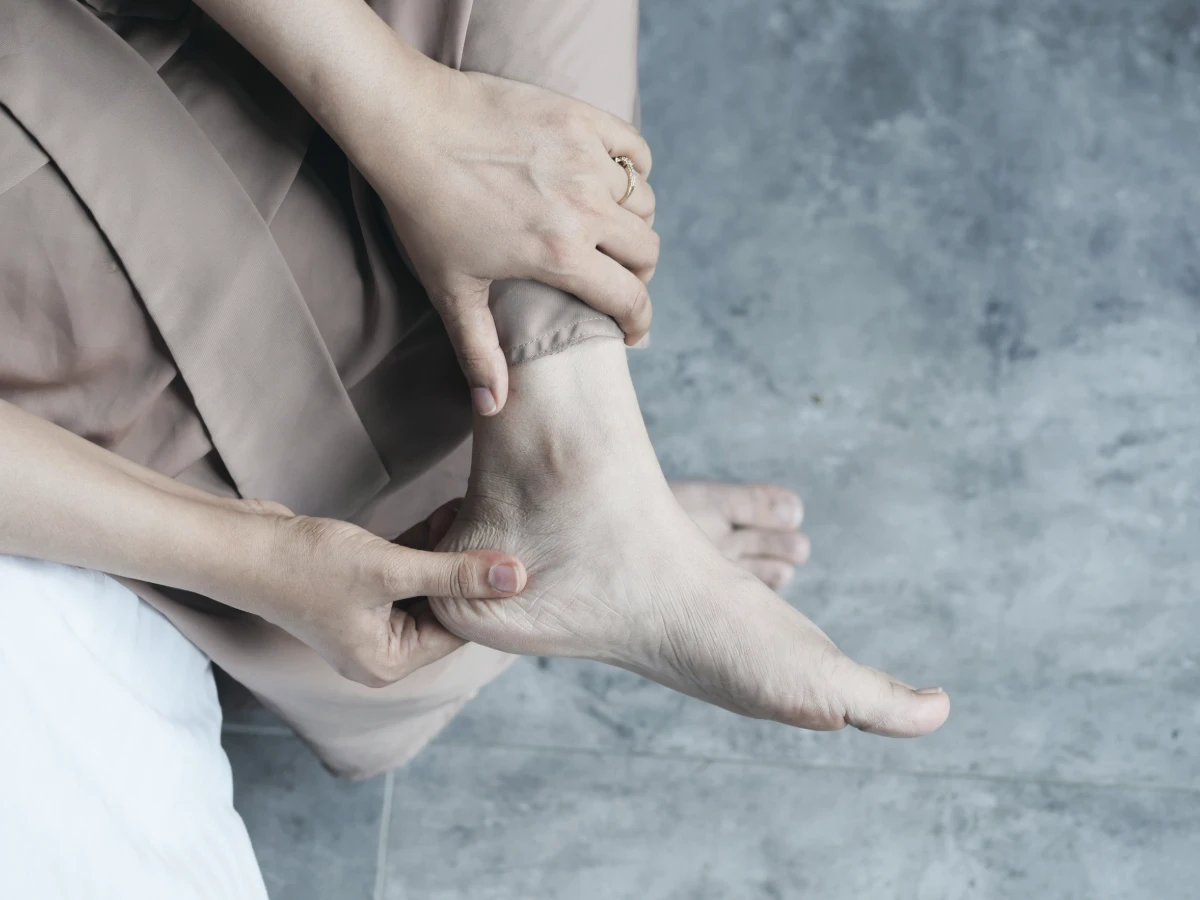
Why this page matters more than any product on this site. Almost every serious foot complication in neuropathy starts as something trivial that nobody noticed: a rub, a small cut, a hot patch, a nail cut too short. Sensation is the alarm that normally catches those in the first hour. When it is reduced, looking is the replacement — and it is free.
The sixty-second routine
Do it at the same point every day. Most people attach it to taking their socks off in the evening, in good light, sitting down.
Color, swelling, any break in the skin. Compare one foot against the other — a difference between them is more informative than either on its own.
Spread them gently apart. This is where moisture collects, where athlete’s foot starts, and where a split can hide completely from view.
Use a mirror on the floor, or a phone camera. Callus with a dark or reddish spot inside it is bruising underneath and needs attention — it is a wound forming, not hard skin.
One foot warmer than the other, or one patch warmer than the rest, can be the earliest sign of infection or of a Charcot process. Use the back of the hand, which judges temperature better than the palm.
Ingrown corners, thickened or crumbling nails, dry cracked heels. Dry, cracked skin on a neuropathic foot is often the autonomic nerves no longer running the sweat glands.
Run your hand all the way to the toe. Grit, a fold in the lining, a seam that has come loose, a curled insole. Do this before you put them on, every single time.
What each finding means
| What you see | What it means | What to do |
|---|---|---|
| Redness that fades within 20 minutes of taking the shoe off | Normal pressure. | Nothing. |
| Redness still there after 20 minutes | The shoe or sock does not fit. This is the earliest warning you get. | Stop wearing that pair. Recheck tomorrow. |
| A blister | Friction you never felt. | Do not pop it. Cover it, keep pressure off, and have it looked at if you have diabetes. |
| Callus with dark or red color inside | Bleeding under the callus. A wound is forming beneath intact-looking skin. | Get it seen. Do not cut or file it yourself. |
| A crack in the heel | Dry skin plus load. A route for infection. | Moisturize daily, avoid the area between the toes, and get a deep crack treated. |
| Softness or whiteness between the toes | Moisture and often fungal infection. | Dry thoroughly after washing; treat athlete’s foot properly. |
| One foot warm, red and swollen with no injury | Possible infection, or Charcot foot. | Urgent. Days, not weeks. |
| Any open sore | An ulcer until proven otherwise. | Get it seen this week. Sooner with diabetes. |
Seeing the parts you cannot see
The sole and the heel are where most ulcers begin, and they are the hardest part to look at. Three approaches work, and it does not matter which you choose:
- A long-handled mirror, or any mirror placed on the floor. The cheapest solution and the one most people settle on.
- A phone camera. Photograph the sole and look at the picture. It has the advantage of a record — comparing today with last week is far more sensitive than memory.
- Another person. If bending or eyesight makes this difficult, ask. It takes them fifteen seconds.
Never do bathroom surgery. No cutting corns or callus, no medicated corn plasters, no razors, no scissors on hard skin. Every one of those causes wounds in feet that cannot report pain, and the medicated plasters work by burning the skin — which is exactly what you do not want on a foot that cannot judge damage.
The four things that undo all of this
Heating pads, hot water bottles, electric blankets, radiators, hot soaks, heated slippers. Burns happen at temperatures that feel mild. This is among the most common preventable injuries in neuropathy and it happens to people trying to feel better.
Indoors counts. Most unnoticed injuries happen at home. A proper house shoe is the fix.
It softens skin and, in hot water, burns it. Wash, dry properly, moisturize — but keep moisturizer out of the spaces between the toes.
You cannot judge fit with reduced sensation. Measure, check by hand, and buy at the end of the day. The full method is here.
Call for an appointment this week if you find
Any open sore, blister, crack or callus with color underneath · redness, warmth, swelling or drainage · any wound at all if you have diabetes · a foot that has become warm, swollen and changed shape without an injury · numbness spreading noticeably further up · new weakness, especially difficulty lifting the front of the foot.
Making it stick
The routine is easy. Remembering it is the hard part, and the people who keep it going all do the same thing: they attach it to something that already happens every day. Taking socks off. Getting into bed. Brushing teeth, with the mirror already in hand.
Two other things help. Keep the mirror where you will see it rather than in a drawer. And photograph anything you are unsure about, so next week you are comparing pictures rather than impressions.
Protect the feet
Footwear is the other half of this routine — what to look for when you cannot judge fit by feel.
Understand the risk
Why loss of protective sensation is the thing that turns a small injury into a serious one.
Bring it to your visit
What to ask, what to bring, and how to describe what you are finding.
Common questions
How often, really?
Every day if sensation is reduced or you have diabetes. It takes a minute, and the whole value is in catching something on day one rather than day ten.
What if I cannot see or reach my feet?
Use a phone camera, or ask someone. If neither is possible, say so at your next appointment — regular professional foot checks exist for exactly this situation and are often a covered benefit.
Can I cut my own toenails?
Straight across, not into the corners, with proper clippers and good light — and only if you can see clearly and your sensation and circulation are reasonable. If any of those is in doubt, have it done professionally. It is a small cost against the alternative.
Is a foot spa or massager safe?
The device is usually not the problem; the heat setting is. We cover what to look for here.
My feet look completely normal. Do I still need to do this?
Yes — that is the point. The check exists to find the first day something is not normal, and you will not feel that day arrive.
For our Michigan neighbors
Not sure what
you are looking at?
A photograph, or the foot itself, settles most questions quickly. Dr. Biernacki’s practice in Howell and Bloomfield Township sees these every week.
Everywhere else, take this page to your own clinician.