Product guides
Slippers for neuropathy
People buy careful, well-fitted shoes for going out, then spend sixteen hours a day barefoot at home — which is where the stubbed toe, the dropped object and the piece of grit are, and where a foot that cannot feel will not tell you any of it happened.
Written by the Managing Neuropathy editorial team under the direction of Dr. Tom Biernacki, DPM, FACFAS · Clinical review pending · Last updated 7 September 2026
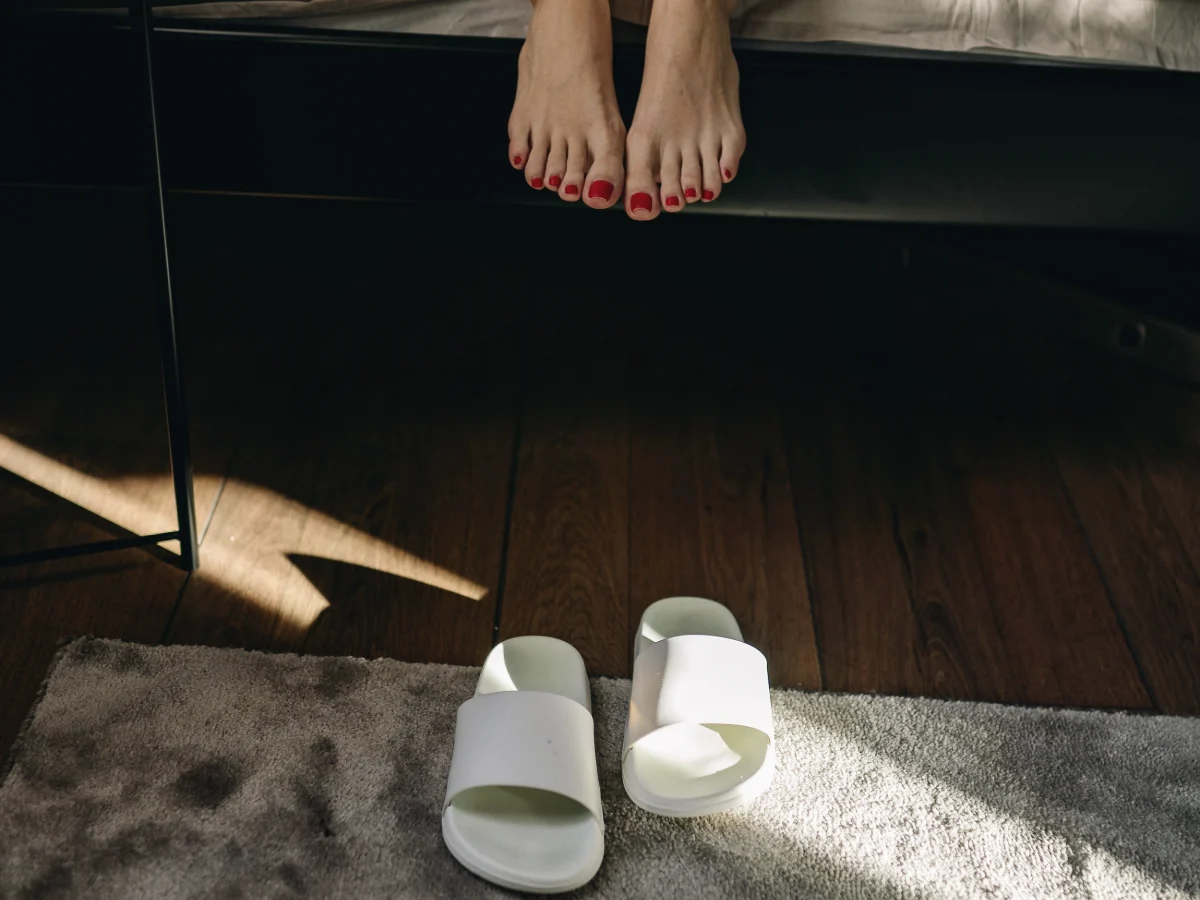
The short answer. If you have reduced sensation, indoor footwear is not a comfort item — it is the same protection your outdoor shoes provide, applied to where you actually spend your time. Closed toe, firm puncture-resistant sole, non-slip outsole, adjustable closure, seamless inside, and a back. Backless slippers are the ones to avoid, for balance as much as for protection.
Why this matters more than it sounds
Ask anyone with neuropathy where they go barefoot and the answer is almost always the same: at home. Getting up in the night, crossing the bathroom, walking to the kitchen. It feels like the safest place in the world, and it is where the injuries happen.
A foot with intact sensation registers the corner of a door frame, a dropped pin, a hot patch of floor, a piece of dry pasta. A foot without it registers none of them. The injury is not felt when it happens, is not felt while it worsens, and is discovered later — sometimes days later — as a wound rather than as a stub. That is the entire mechanism behind most of what goes wrong in a neuropathic foot, and it is the argument for wearing something indoors.
The other half of the argument is falls. Balance is already affected when position sense is reduced, and the wrong indoor footwear makes that measurably worse.
What a house shoe needs
Open-toe slippers leave the part of the foot most likely to be stubbed completely exposed. This is the single most important feature.
Press your thumb into it. If it folds easily or compresses to nothing, it will not stop a tack, a shard or a piece of glass. Soft is not the same as protective.
Backless slippers are held on by gripping with the toes, which changes how you walk and is associated with tripping in older adults. A closed heel or an adjustable strap keeps the foot in the shoe without the foot working for it.
Rubber with real tread, not smooth felt or suede. Kitchens and bathrooms are wet, and this is where falls happen.
Velcro or a strap, so the fit can change through the day. Feet swell, and a slipper that fits at breakfast can be tight by evening — and you will not feel it becoming tight.
Run your hand all the way round the inside. Any seam, tag or ridge is a pressure point sitting against skin that cannot report it.
If you wear orthotics or diabetic inserts, they belong in the shoes you wear most — which for many people is the indoor pair.
A wide opening and a long pull tab. Footwear that is a struggle to put on gets skipped, and footwear that gets skipped protects nobody.
What to avoid
| Avoid | Why |
|---|---|
| Backless slippers and mules | Held on by toe grip, which alters gait and is linked to trips. The most common indoor footwear and the least suitable here. |
| Open-toe styles | They leave the toes exposed to exactly the injuries that cause the problem. |
| Thin fabric or felt soles | No puncture protection and poor grip on hard floors. |
| Memory foam as the only sole | Comfortable, and it bottoms out. Comfort underfoot is not protection through the sole. |
| Anything worn outdoors as well | Grit and small stones get carried inside and end up under a foot that cannot feel them. |
| Slippers that have gone soft | The sole compresses over months. When it has flattened, the protection has gone even though the slipper looks fine. |
Fitting, when you cannot judge fit by feel
The usual rule applies and it matters more here: fit by measurement and by hand, not by sensation. Buy or try at the end of the day when feet are at their largest. Check that there is room in front of the longest toe, which is not always the big toe. Slide your hand right around the inside for seams and ridges before the first wear. And after the first hour of wearing a new pair, take them off and look at your feet in good light — redness that has not faded within twenty minutes means the fit is wrong, whatever it felt like. The full fitting method is here.
Wearing them well
Keep the pair beside the bed and put them on before your feet touch the floor — the night-time trip to the bathroom is the classic moment for both an unnoticed injury and a fall. Shake them out before putting them on, every time. Keep them for indoors only. And look inside and at your feet as part of the daily check rather than as a separate task. The routine is here.
Never warm your slippers, and never wear heated slippers. Warming footwear on a radiator, in a microwave, or by using an electrically heated pair is a recurring cause of burns in feet that cannot judge temperature. Warm socks are fine. Applied heat is not.
A note on Medicare
The therapeutic shoe benefit that covers footwear for qualifying patients with diabetes is written around shoes and inserts. It does not extend to slippers or house shoes, so this is an out-of-pocket purchase even for people who qualify for covered footwear. That is worth knowing in advance rather than at the counter — and it is an argument for choosing a well-made supportive pair once rather than a cheap pair repeatedly. How the shoe benefit actually works is here.
Specific product recommendations
We have not published named picks in this category, and we are in no hurry to. Our editorial policy requires that we be able to state what was assessed and how before recommending anything by name. When picks appear here, they will be judged against the eight features above — closed toe, firm sole, secure back, real tread, adjustable closure, seamless lining, removable insole and easy entry — rather than on commission.
Affiliate relationship: when picks are published, some links will be affiliate links and we may earn a commission from qualifying purchases at no additional cost to you. As an Amazon Associate I earn from qualifying purchases. See our affiliate disclosure.
Common questions
Can I just wear socks around the house?
Socks give no puncture protection and are slippery on hard floors, which makes them poor on both counts that matter here. If you want warmth plus protection, wear a seamless sock inside a proper house shoe.
Are diabetic slippers a real category?
The label is marketing, not a standard. Judge the features rather than the word — a slipper labelled diabetic with an open toe and a felt sole is worse than an unlabelled one with a closed toe and a rubber outsole.
What about wide feet or swelling?
Look for adjustable closures and extra depth rather than simply a bigger size. A longer slipper does not solve a width problem, and it introduces a trip hazard of its own.
How often should I replace them?
Judge by the sole rather than by the upper. When it has compressed and no longer resists a firm thumb press, its protective value has gone even if the slipper still looks presentable.
My feet get cold. Can I use a heated slipper?
No. Cold feet in neuropathy are common, and applied heat in a foot that cannot judge temperature is one of the most reliable ways to sustain a burn. Wear warmer socks and a closed house shoe instead, and mention persistently cold feet to a clinician, since circulation deserves checking.
Related reading
Choosing shoes · Shoes and the Medicare benefit · Socks, honestly · The daily foot check · Neuropathy in the feet
Sources and further reading: American Diabetes Association Standards of Care, foot-care section, including advice against going barefoot and the role of appropriate footwear in preventing ulceration. National Institute of Diabetes and Digestive and Kidney Diseases (NIDDK), diabetic foot care, including guidance against heat and soaking. US Centers for Medicare & Medicaid Services, Therapeutic Shoes for Persons with Diabetes benefit scope. Published falls-prevention guidance on indoor footwear in older adults.
This page is general education and is not a diagnosis, a treatment plan, or advice to start or stop any medicine. Clinical review by Dr. Biernacki is pending; the review date will be shown here once complete.
For our Michigan neighbors
Most foot injuries
happen at home.
A sensation test tells you how much protection you actually need indoors. Dr. Biernacki’s Michigan practice can measure it and check what you are already wearing.
Everywhere else, take this page to your own clinician.

Dr. Tom Biernacki, DPM, FACFAS is a double board-certified foot and ankle surgeon (ABFAS and ABPM) and a Fellow of the American College of Foot & Ankle Surgeons. He is the founder of Balance Foot & Ankle in Howell and Bloomfield Township, Michigan, where peripheral neuropathy, diabetic foot risk and loss of protective sensation are part of his weekly clinic. His patient education videos have drawn more than 950,000 subscribers on YouTube. He writes Managing Neuropathy to put the explanation he gives in the exam room in front of the people who cannot get to one — including when a product is worth buying and when it is not.