Product guides
Choosing a foot drop brace
A brace is the right answer to the tripping. It is the wrong answer to the question of why the front of your foot stopped lifting — and in a numb leg, a rigid device pressed against skin that cannot report pressure creates a second problem worth planning for.
Written by the Managing Neuropathy editorial team under the direction of Dr. Tom Biernacki, DPM, FACFAS · Clinical review pending · Last updated 7 September 2026
The short answer. A new foot drop needs a diagnosis before it needs a purchase — several causes are treatable and a few are urgent. Once that is settled, a brace prevents falls and is worth having. The two things people are not told: a brace changes what shoes you can wear, and in a leg with reduced sensation it must be checked for pressure damage the skin can no longer report.
What foot drop actually is
Foot drop is weakness of the muscles that lift the front of the foot. The toes catch on the ground during the swing phase of walking, so people compensate by lifting the knee higher than usual — a steppage gait — or by swinging the leg outward. You may hear the foot slap down at the end of each step.
It is not a disease. It is the visible end of a problem somewhere along a chain: the nerve that supplies those muscles, the nerve root it comes from, or the control system above that.
Why the cause has to come first
This is the part a brace listing will never tell you, and it is the reason this page starts here.
- A compressed peroneal nerve at the outer knee — from crossing the legs, prolonged squatting or kneeling, a cast, or significant weight loss — often recovers, and recovers better when the compression is identified and removed early.
- An L5 nerve root problem in the lower back is a common cause and is managed very differently from a nerve problem at the knee.
- Peripheral neuropathy can produce weakness at the front of the foot as it progresses, and in that setting the cause of the neuropathy is the thing worth treating.
- Neurological conditions — stroke, multiple sclerosis, motor neurone disease and inherited neuropathies such as Charcot-Marie-Tooth — present this way too, and they need naming rather than bracing around.
See someone within days, not months, if foot drop came on suddenly; it followed back pain, an injury or surgery; it is getting worse week to week; it comes with numbness spreading up the leg, bladder or bowel changes, or weakness elsewhere. A brace bought online does not stop a treatable cause from becoming permanent.
The main types of brace
| Type | What it is | Suits |
|---|---|---|
| Posterior leaf spring AFO | A thin plastic ankle-foot orthosis that sits behind the calf and under the foot, flexing to lift the toes. | The common starting point for straightforward foot drop with a flexible ankle. |
| Carbon fiber AFO | Lighter and springier, storing and returning energy through the step. | More active walkers. Usually more expensive. |
| Solid or hinged AFO | More rigid, controlling the ankle in more than one plane. | Weakness beyond simple toe lift, instability, or spasticity. |
| Dorsiflexion-assist strap | A cuff around the calf with an elastic strap to the shoe laces — the “foot-up” style. | Mild cases and people who cannot tolerate a rigid device. Least support, most discreet. |
| Functional electrical stimulation | A cuff below the knee that stimulates the nerve to lift the foot as you walk. | Selected neurological cases, prescribed and fitted by a specialist. Expensive, and not right for every cause. |
The neuropathy problem nobody puts on the box
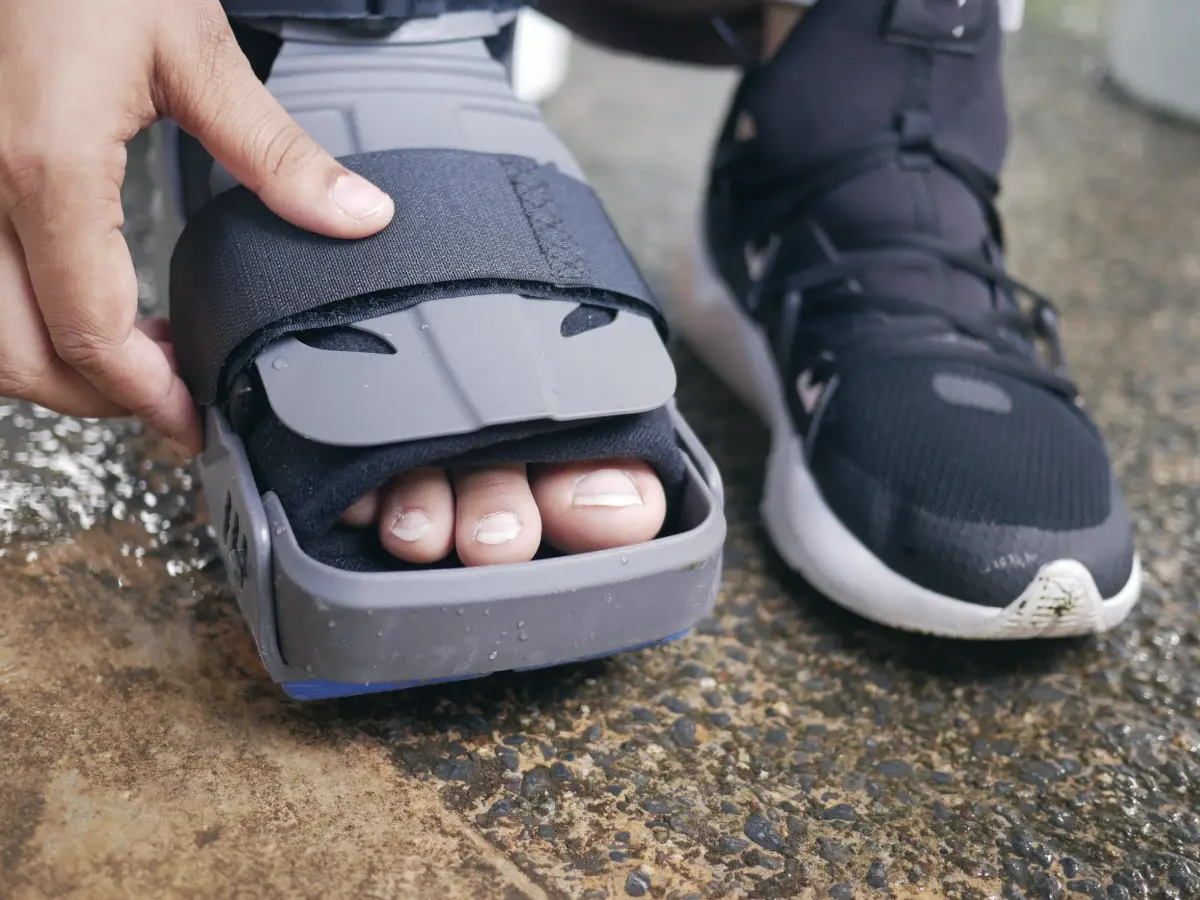
Every brace works by pressing plastic or carbon against a leg and a foot. In an ordinary limb the wearer feels a rub developing and adjusts. In a limb with reduced sensation — which is exactly the population this device is often sold to — that warning does not arrive.
Pressure injuries from braces are a recognized problem, they happen fastest over the bony points, and in a foot with poor circulation a rub can become a wound that takes months. If you have any numbness, treat the brace as a device that requires supervision, not just a purchase.
Short spells to begin with, building up. Not a full day on day one.
Especially the outer ankle bone, the top of the foot, the heel and the back of the calf.
Any redness that has not faded twenty minutes after removing the brace means it does not fit. Stop wearing it and get it adjusted.
A seam trapped under a rigid shell is a predictable place for a wound to start. What to look for in a sock is here.
An orthotist can reshape it properly. A home fix usually moves the pressure rather than removing it.
Days, not weeks — particularly with diabetes. Daily inspection matters more here than anywhere.
The shoe problem
A brace takes up room inside the shoe, and this is where most people discover their existing shoes will not work.
You need a shoe with a removable insole, so the brace footplate can take its place, and extra depth to accommodate it. Laces or straps that open wide help you get the braced foot in at all. And because the brace adds height under that foot, the two shoes can end up effectively different heights — a lift on the other side sometimes solves a limp people assume is the brace failing.
Buy shoes with the brace on, at the end of the day, and check by hand rather than by feel if sensation is reduced. The full fitting method is here.
Off-the-shelf or custom?
Off-the-shelf braces are inexpensive, immediately available, and adequate for many straightforward cases. Custom devices are moulded to your leg, cost considerably more, and are the right answer where the ankle is not flexible, where there is deformity, where sensation is reduced enough that pressure distribution matters, or where an off-the-shelf device has already caused rubbing.
One practical note: ankle-foot orthoses are durable medical equipment, and with a prescription and documented need they are frequently a covered benefit rather than an out-of-pocket purchase. Ask before you buy retail — a device fitted by an orthotist and paid for by your plan is usually both cheaper and better than the same money spent online.
What a brace does not fix
It does not treat the cause, it does not strengthen the muscle, and it does not address balance. Physical therapy alongside a brace is what maintains ankle range of movement — a stiff ankle that loses flexibility becomes much harder to brace — and works on the balance and gait changes that make falls likely. Ask for that referral; it is one of the most commonly skipped parts of the plan.
Specific product recommendations
We have not published named picks in this category, and we are in no hurry to. Our editorial policy requires that we be able to state what was assessed and how before recommending anything by name — and bracing is a category where fit, cause and sensation matter more than the product, so a generic pick can genuinely cause harm. If picks appear here, they will be judged on adjustability, edge finishing at the pressure points, and shoe compatibility.
Affiliate relationship: when picks are published, some links will be affiliate links and we may earn a commission from qualifying purchases at no additional cost to you. As an Amazon Associate I earn from qualifying purchases. See our affiliate disclosure.
Common questions
Can foot drop be reversed?
It depends entirely on the cause. Compression of the peroneal nerve at the knee often improves once the compression is removed, and a nerve root problem may respond to treatment of the back. Where the cause is a progressive neurological condition, the brace becomes the long-term management. This is why the diagnosis is worth more than the device.
Do I need a prescription?
Not to buy a simple strap online. You do need one for a fitted or custom device and for insurance to cover it — and getting a clinician involved is how the cause gets identified anyway.
Can I wear a brace with any shoe?
No. You need a removable insole and extra depth. Sandals, slip-ons and most dress shoes will not take an ankle-foot orthosis.
Will it make my muscles weaker?
The common worry, and mostly unfounded for the muscles involved in foot drop, where the weakness comes from the nerve rather than from disuse. Physical therapy alongside is still worth doing for ankle range and balance.
My foot drop came with numbness. Does that change anything?
Yes, in two ways. It suggests the nerve problem involves sensory fibers as well as motor ones, which is worth investigating. And it means the brace needs the skin-checking discipline set out above, because you will not feel a pressure problem developing.
Related reading
Neuropathy in the feet · Numb toes: reading the pattern · Choosing shoes · Socks under a brace · The daily foot check · Which doctor to see
Sources and further reading: National Institute of Neurological Disorders and Stroke (NINDS), foot drop and peripheral neuropathy. American Academy of Orthopaedic Surgeons patient information on foot drop and ankle-foot orthoses. American Diabetes Association Standards of Care, foot-care section on pressure, footwear and skin inspection in the insensate foot. US Centers for Medicare & Medicaid Services coverage framework for ankle-foot orthoses as durable medical equipment.
This page is general education and is not a diagnosis, a treatment plan, or advice to start or stop any medicine. Clinical review by Dr. Biernacki is pending; the review date will be shown here once complete.
For our Michigan neighbors
A new foot drop
should be examined.
Some causes recover if they are found early, and a braced foot with reduced sensation needs its skin watched. Dr. Biernacki’s Michigan practice handles both.
Everywhere else, take this page to your own clinician.

Dr. Tom Biernacki, DPM, FACFAS is a double board-certified foot and ankle surgeon (ABFAS and ABPM) and a Fellow of the American College of Foot & Ankle Surgeons. He is the founder of Balance Foot & Ankle in Howell and Bloomfield Township, Michigan, where peripheral neuropathy, diabetic foot risk and loss of protective sensation are part of his weekly clinic. His patient education videos have drawn more than 950,000 subscribers on YouTube. He writes Managing Neuropathy to put the explanation he gives in the exam room in front of the people who cannot get to one — including when a product is worth buying and when it is not.