Product guidance · Socks
Neuropathy socks: what helps, what is marketing, and one real warning
Socks are the cheapest thing you can change and the layer sitting against your skin all day. They are also the category with the most confident nonsense attached to it.
Written by the Managing Neuropathy editorial team under the direction of Dr. Tom Biernacki, DPM, FACFAS · Clinical review pending · Last updated 6 September 2026
The short answer. A good sock for neuropathy is seamless at the toe, has no tight elastic band at the top, moves moisture away from the skin, fits without bunching, and gets changed every day. No sock treats nerve damage. And if you have poor circulation, compression socks are a question for your clinician before they are a purchase.
Start with the warning, because it is the part that matters most
“Compression socks for neuropathy” is one of the most common searches in this category, and the framing is wrong in a way that occasionally causes harm.
Compression treats venous problems — swelling, venous insufficiency, blood pooling in the lower leg. Those are real conditions and compression genuinely helps them. But compression does not treat peripheral neuropathy. It does not repair nerves, and it does not restore sensation. If you have neuropathy and swelling, compression may be appropriate for the swelling. That is a different sentence from “compression helps neuropathy.”
The safety issue. Peripheral artery disease — narrowed arteries reducing blood flow into the leg — frequently occurs alongside diabetic neuropathy, in the same people, for the same underlying reasons. Compression squeezes a limb. If the arterial supply into that limb is already marginal, adding external pressure can reduce it further, and the person least likely to notice the resulting damage is precisely the person whose sensation is impaired.
This is why compression should follow an assessment of your circulation, not a product review. Ask your clinician to check the blood flow in your legs before you wear compression. If you have been told you have poor circulation, PAD, or an abnormal ankle-brachial index, do not start compression on your own.
None of this means compression is bad. It means it is a medical decision with a real contraindication, being sold as a comfort accessory.
What actually matters in a sock
Seamless at the toe
The toe seam is the classic offender. It is a raised ridge of thread sitting directly across the top of the toes, and in a foot with reduced sensation it can rub for hours without registering. Look for socks described as seamless or with a hand-linked toe closure. Turn the sock inside out and feel the toe with your fingers — if you can feel a ridge, so can your skin, even if you cannot.
No constricting band at the top
Standard socks hold themselves up with tight elastic. On a leg that swells, that band leaves a deep indentation, and it restricts return flow at exactly the wrong point. Non-binding or loose-top socks solve this. The test is simple: take the sock off after a day’s wear and look at your leg. A visible dent means the sock is too tight, regardless of how it felt going on.
Moisture management
Damp skin breaks down more easily and grows fungus more readily, and neuropathy often comes with altered sweating — some people’s feet get much drier, others much damper. Fibers that move moisture away from the skin (merino wool, bamboo, or engineered synthetics) generally outperform plain cotton, which holds moisture against the skin once it is wet. Cotton is not dangerous; it is just the weakest performer in the one job that matters here.
Fit, without bunching
A sock too large wrinkles, and a wrinkle is a pressure ridge. A sock too small pulls the toes together and stretches thin across the widest part of the foot. Buy your actual size, and if you are between sizes on a brand’s chart, the fit that lies flat wins.
Padding, where you need it
Extra cushioning under the ball of the foot and the heel reduces peak pressure at the two places that take the most load. This is genuinely useful. It also adds bulk — so if you add padded socks, re-check that your shoes still have room. A thick sock in a shoe fitted for a thin one converts a good shoe into a tight one.
Light-colored, at least some of the time
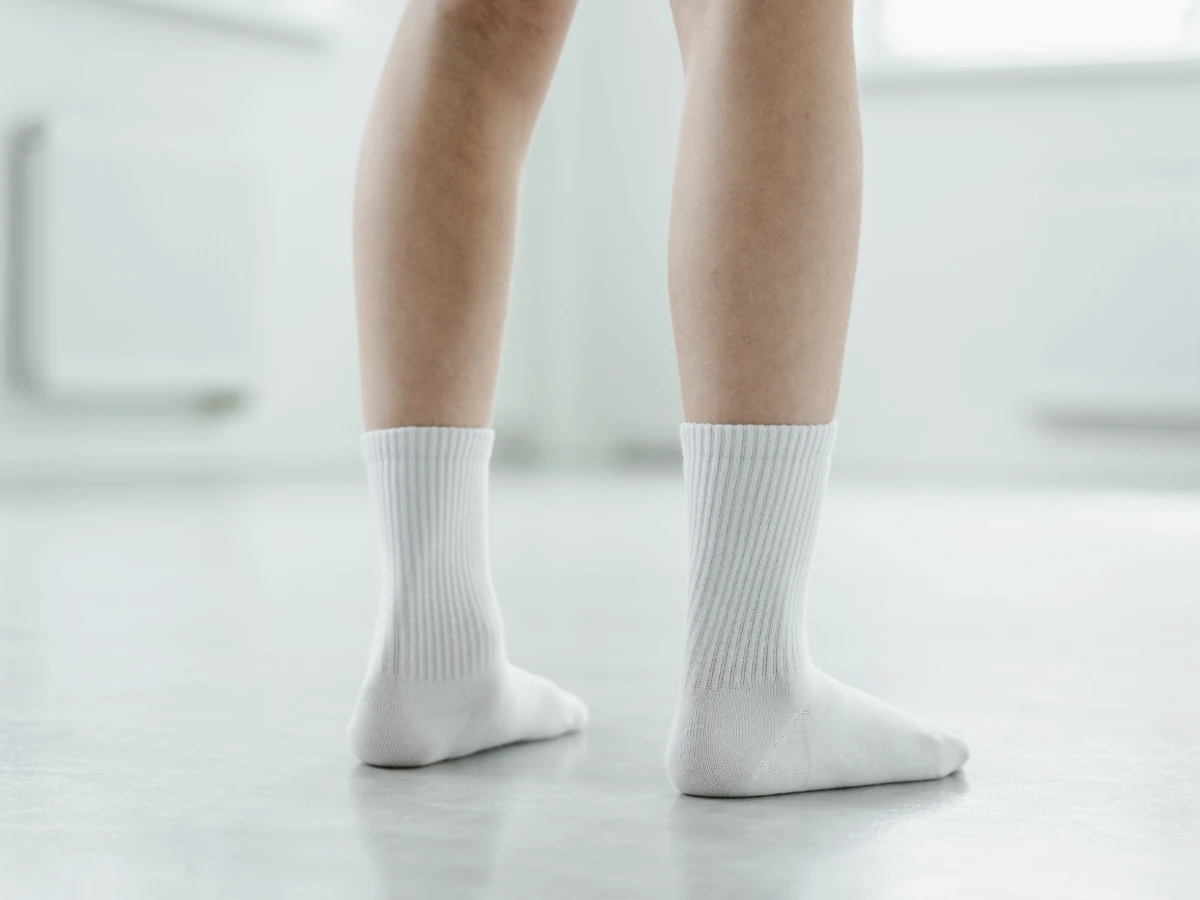
An old clinical habit with a real rationale: on a white or pale sock, blood, drainage, or discharge from a wound you did not feel shows up immediately. On a black sock it does not. Many people alternate — dark socks when they want them, pale socks as a routine check.
Are “diabetic socks” worth it?
Partly. The term is not regulated, so it describes a marketing category rather than a standard. Some socks sold as diabetic socks genuinely have the features above — seamless toe, non-binding top, moisture-wicking fiber, cushioned sole. Those features are worth having, and if a sock has them the label is a convenient shorthand.
Other products carry the label and little else, at a markup. And some make claims — improving circulation, relieving nerve pain, reversing numbness — that no sock can support.
Judge the sock by its construction, not its category name. A well-made merino hiking sock with a smooth toe and a relaxed cuff may serve you better than something branded for your diagnosis.
Things that are not true
- Socks do not treat neuropathy. No fiber, weave, mineral, copper infusion, or far-infrared claim repairs a peripheral nerve. Copper and silver have antimicrobial properties, which is a different claim from treating nerve damage.
- Grounding or “earthing” socks do not have credible evidence for treating neuropathy.
- Tighter is not better. More compression is not more benefit, and in the wrong circulation it is the opposite.
- Warmth is not sensation. Heated socks and hot water bottles are a genuine burn risk in a foot that cannot report temperature accurately. Never apply direct heat to a numb foot.
The daily habits that matter more than the sock
This is the highest-value habit in the whole category.
A repair is a ridge. Replace rather than mend.
A sock will not save you from a stone, a fold, or something that got in overnight.
Top, sole, heels, and between the toes. Every day. This is how problems get caught early.
When to get seen
Socks are not the answer to any of the following. See a clinician promptly for an open sore or blister, redness or warmth or drainage, a wound that is not healing, new swelling in one leg, skin that is turning dark, or leg pain when walking that eases when you stop — that last one is a circulation symptom and it is directly relevant to whether compression is safe for you.
Specific product recommendations
We have not published named picks here yet. Our editorial policy requires that we be able to state what was assessed and how before we recommend a product by name, and socks are a category where that discipline matters — the claims are loud and the construction differences are real but hard to see in a listing photograph.
Affiliate relationship: when picks are published, some links will be affiliate links and we may earn a commission from qualifying purchases at no additional cost to you. As an Amazon Associate I earn from qualifying purchases. See our affiliate disclosure.
Common questions
Can I wear compression socks if I have diabetes?
Possibly, but not without your circulation being checked first. Diabetes raises the risk of peripheral artery disease, and compression on a limb with poor arterial supply can do harm. Ask your clinician to assess blood flow before you start.
Should I sleep in socks?
Often reasonable for warmth and dryness, provided they are loose and non-binding. Never sleep in compression socks unless a clinician has specifically told you to, and never use heated socks or a hot water bottle on a numb foot.
How often should socks be replaced?
When the cushioning flattens, the cuff stops holding gently, or any hole or thin patch appears. Socks are cheap relative to what a foot wound costs you.
Do I need a different sock for walking?
A cushioned, moisture-wicking sock in the correct size is a good default for activity. Re-check your shoe fit with the thicker sock on.
Related reading
Best shoes for neuropathy · Daily foot care · Symptoms and causes
Sources and further reading: National Institute of Diabetes and Digestive and Kidney Diseases (NIDDK), diabetes and foot-care guidance. American Diabetes Association Standards of Care, neuropathy and foot-care section. Society for Vascular Surgery guidance on peripheral artery disease and compression contraindications.
This page is general education and is not a diagnosis or a treatment plan for your feet. Clinical review by Dr. Biernacki is pending; the review date will be shown here once complete.
For our Michigan neighbors
Have your circulation
actually checked.
Whether compression is safe for you is a question an examination answers. Dr. Biernacki’s Michigan practice can assess circulation and sensation together.
Everywhere else, ask your own clinician before starting compression.

Dr. Tom Biernacki, DPM, FACFAS is a double board-certified foot and ankle surgeon (ABFAS and ABPM) and a Fellow of the American College of Foot & Ankle Surgeons. He is the founder of Balance Foot & Ankle in Howell and Bloomfield Township, Michigan, where peripheral neuropathy, diabetic foot risk and loss of protective sensation are part of his weekly clinic. His patient education videos have drawn more than 950,000 subscribers on YouTube. He writes Managing Neuropathy to put the explanation he gives in the exam room in front of the people who cannot get to one — including when a product is worth buying and when it is not.