
Symptoms and causes
Foot drop
Foot drop is not a diagnosis. It is a sign that one specific muscle group has lost its nerve supply — and the whole question is where along that nerve the interruption sits.
Written by the Managing Neuropathy editorial team under the direction of Dr. Tom Biernacki, DPM, FACFAS · Clinical review pending · Last updated 7 September 2026
The short answer. Foot drop means you cannot lift the front of the foot against gravity. The muscles that do that job are supplied by the deep peroneal (fibular) nerve, and the signal reaches them by a long route: spinal cord, L4 and L5 nerve roots, sciatic nerve, then around the outside of the knee, where the nerve sits directly on bone under thin skin. An interruption anywhere on that route produces the same slapping, catching gait. Finding the level is what decides treatment, and the examination findings above the ankle are what find it.
What it looks like before anyone names it
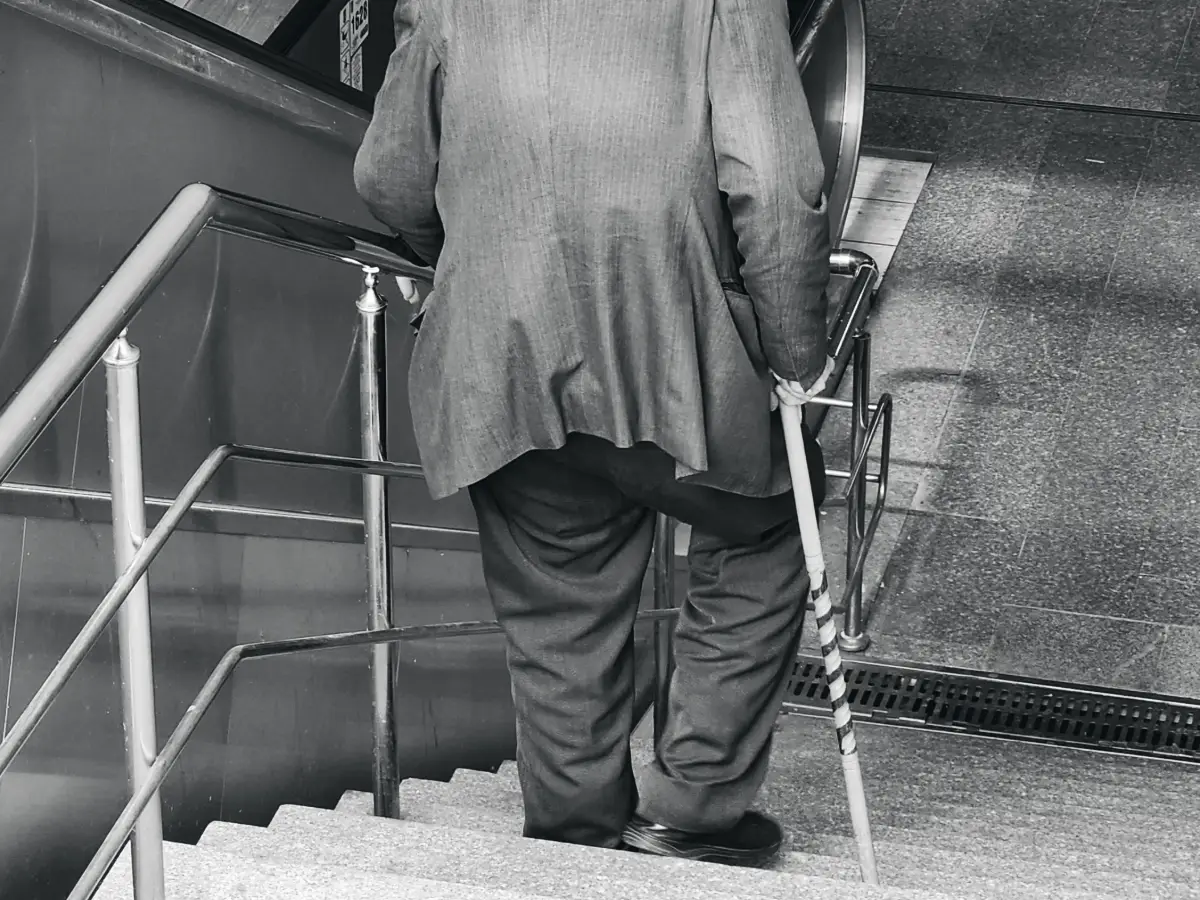
People rarely arrive saying “I have foot drop.” They say they keep catching their toe on kerbs, or on the edge of carpet, or on the lip of a step. They notice the front of the shoe scuffing on one side only. Someone else hears the slap of the foot landing. To clear the ground, the hip and knee lift higher than usual, producing the high-stepping walk clinicians call a steppage gait.
Two features separate it early. It is almost always one-sided, and it is weakness rather than sensation — which is exactly why it is easy to dismiss for months. There is often no pain at all.
Where the interruption usually is
Five levels account for most cases, and they are distinguishable at the bedside.
| Level | Typical story | The clue that gives it away |
|---|---|---|
| Peroneal nerve at the outside of the knee | Habitual leg crossing, prolonged squatting or kneeling, a tight cast or brace, rapid weight loss, a long operation or hospital stay, a blow to the outer knee | Tenderness or tingling when the outside of the knee is tapped; ankle eversion weak; foot inversion strong |
| L5 nerve root in the back | Back or buttock pain, sometimes a history of a disc problem | Weak inversion as well as eversion; symptoms in a stripe down the outside of the leg; worse with coughing or straining |
| Sciatic nerve higher in the thigh | Hip surgery, injection injury, pelvic trauma | Hamstring weakness and wider sensory loss than a knee-level lesion |
| A generalised polyneuropathy | Long-standing numbness and burning in both feet first | Both sides involved, sensory loss in a stocking pattern, ankle reflexes absent |
| Central causes — stroke, cord or motor neurone disease | Sudden onset, or spreading weakness elsewhere | Brisk reflexes, spasticity, weakness in other muscle groups |
The single most useful bedside test is foot inversion — turning the sole inwards. That muscle is supplied by the tibial nerve but by the same L5 root. If inversion is weak too, the problem is more likely at the root than at the knee. It is a thirty-second test that changes which scan gets ordered.
The leg-crossing cause is more common than people expect
At the outside of the knee, the peroneal nerve wraps around the neck of the fibula with almost nothing over it. Anything that presses there for long enough can silence it: sitting with the legs crossed for hours, kneeling to lay flooring, a plaster cast, sleeping heavily sedated in one position, or losing enough weight that the fat pad that used to cushion the nerve has gone. This is the version with the best outlook, and also the version people are most likely to keep re-causing after it improves.
Why the clock matters
New or worsening foot drop is not a wait-and-see problem. Get it assessed promptly, and urgently if it came on suddenly, if it followed an injury, if it affects both sides, if there is back pain with numbness around the groin or a change in bladder or bowel control, or if weakness is spreading. A muscle that has been without its nerve for many months recovers far less well than one reinnervated early, and the ankle can stiffen into a position it cannot come back from.
If the foot drop appeared right after a surgery, a cast, or a long procedure and nobody acted on it, that is a separate question from treatment, and a fair one to ask. Dr. Biernacki reviews foot drop and peroneal nerve injury cases for attorneys on both sides. That page sets out what the medical record has to show — a baseline motor exam, when the deficit was first documented, when nerve studies were run — which is a useful checklist even if you never speak to a lawyer.
Keeping the ankle from stiffening
This is the part that gets neglected while everyone waits for tests. If the front of the ankle cannot lift, the calf and Achilles sit shortened all day and gradually tighten. Left alone, the temporary problem becomes a fixed one, and then even a nerve that recovers cannot restore a normal step. Daily calf and Achilles stretching, a splint that holds the foot at a right angle at night, and physiotherapy for gait are the low-cost measures that protect the outcome regardless of the cause.
Braces and what they actually do
An ankle-foot orthosis holds the foot up so the toe clears the ground. It does not treat the nerve; it prevents the falls and the tripping while the nerve question is settled, and it protects the ankle from stiffening. The main types differ more than the marketing suggests:
- Rigid or semi-rigid plastic AFOs sit inside the shoe against the back of the calf. They control the foot most reliably and are what a complete drop usually needs. They demand a roomy shoe with a removable insole.
- Posterior leaf-spring designs are thinner and flex a little, giving a more natural push-off for partial weakness.
- Strap-and-cuff or lace-attachment devices pull the shoe upward from a calf strap. They are the least bulky and the least controlling, and are best for mild cases.
- Functional electrical stimulation devices stimulate the nerve to fire during the swing phase, and only suit certain causes.
Two practical points no product page mentions. First, a brace changes shoe fit substantially — expect to need a deeper shoe, and expect the braced side to need more room than the other. Second, if sensation is reduced, a brace edge can rub a hole in skin that never reports the pressure; the skin under and around any device needs checking every single day. The daily check is here.
Specific product recommendations
We have not published named picks for braces, and we will not until we can state what was assessed and how. Our editorial policy requires it. When picks appear here they will be judged on fit under an ordinary shoe, edge design where skin is numb, and adjustability — not on commission. When picks are published some links will be affiliate links and we may earn a commission at no additional cost to you. As an Amazon Associate I earn from qualifying purchases. See our affiliate disclosure.
Fit a brace to the cause, not to the symptom. A brace bought online before anyone has established the level of the lesion can quietly delay the diagnosis that mattered — particularly a compressive lesion at the knee that would have recovered if the pressure had been removed.
What recovery usually looks like
It depends almost entirely on the level and the mechanism. Compression at the knee that is recognized and relieved often improves over weeks to a few months. A nerve root problem follows the course of the underlying spinal issue. A nerve damaged as part of a generalised polyneuropathy follows that disease. Nerve regrowth, where it happens at all, is measured in millimetres per day, which is why a leg-length nerve is a matter of months rather than weeks — and why the stretching and the brace matter throughout.
Common questions
Is foot drop the same as peroneal neuropathy?
No. Peroneal neuropathy — compression of that nerve, usually at the outside of the knee — is one cause of foot drop, and a common one. Foot drop is the sign; peroneal neuropathy is one of several explanations for it.
Can foot drop come from diabetes?
Yes, by two routes. A generalised diabetic polyneuropathy can weaken the lifting muscles on both sides, and diabetic nerves are also more vulnerable to compression at pressure points such as the outside of the knee, so a single-sided drop can appear after ordinary positioning.
Will exercises alone fix it?
Exercise cannot regrow a nerve. What it does is preserve ankle range, maintain the muscle that is still innervated and retrain a safe walking pattern, all of which protect the result if the nerve does recover. That is worth doing from day one.
Why does my toe catch even though I can lift my foot when I am sitting?
Testing the movement while seated is easier than doing it repeatedly during walking. Partial weakness shows up as fatigue over a few hundred meters, which is why the toe catches later in the day or at the end of a walk.
Which specialist should I see?
It depends on the suspected level. A neurologist for nerve conduction studies, a spine specialist if the root is implicated, and a podiatrist or orthotist for the brace, the shoe fit and the skin. Who does what is set out here.
Related reading
The full symptom list · Back nerve pain versus neuropathy · Numb toes and the pattern · Which doctor treats neuropathy · Choosing shoes with a brace · The daily foot check
Sources and further reading: Standard clinical texts on peroneal (fibular) neuropathy and the localisation of foot drop. American Academy of Neurology guidance on electrodiagnostic assessment of focal neuropathies. Published reviews of ankle-foot orthosis prescription and functional electrical stimulation in drop foot. American Diabetes Association Standards of Care, neuropathy and foot care sections.
This page is general education and is not a diagnosis or a treatment plan. Clinical review by Dr. Biernacki is pending; the review date will be shown here once complete.
For our Michigan neighbors
Foot drop needs the level
found, not just a brace.
Examination, gait assessment, skin protection and the right orthosis, plus referral for nerve testing where it is warranted. Dr. Biernacki’s Michigan practice does that work.
Everywhere else, take this page to your own clinician.

Dr. Tom Biernacki, DPM, FACFAS is a double board-certified foot and ankle surgeon (ABFAS and ABPM) and a Fellow of the American College of Foot & Ankle Surgeons. He is the founder of Balance Foot & Ankle in Howell and Bloomfield Township, Michigan, where peripheral neuropathy, diabetic foot risk and loss of protective sensation are part of his weekly clinic. His patient education videos have drawn more than 950,000 subscribers on YouTube. He writes Managing Neuropathy to put the explanation he gives in the exam room in front of the people who cannot get to one — including when a product is worth buying and when it is not.