Symptoms & causes
Cold feet: why they happen, and when it’s your nerves or your circulation
Most cold feet are simply feet doing their job, giving up heat to protect the rest of the body. Feet that stay cold, change color, or feel cold while being warm to the touch are telling you something more specific, and a simple touch test points you in the right direction.
Written by the Managing Neuropathy editorial team under the direction of Dr. Tom Biernacki, DPM, FACFAS · Clinical review pending · Last updated 16 October 2026
The short answer. Feet are the first place the body turns down blood flow to save heat, so cold feet in a cool room are normal. Feet that are cold to the touch most of the time, look pale or bluish, or come with calf pain when you walk point to circulation. Feet that feel cold to you but warm to someone else’s hand point to the nerves. If you feel cold all over and tired, ask for a thyroid test, a blood count and iron studies. One foot that suddenly turns cold and pale is an emergency.
Start with the touch test
Before anything else, find out whether your feet are actually cold. Ask someone to hold your foot in a warm hand, or compare it with the skin of your shin. The answer splits the causes in two.
- Cold to the touch: blood flow to the feet is reduced. That can be normal, in a cold room or when you are stressed, or it can be Raynaud’s, narrowed arteries, smoking or a medicine.
- Feels cold, but warm to the touch: the problem is the signal, not the temperature. Damaged nerves can send a false message of cold, burning or numbness, which is common in peripheral neuropathy.
Treat it as a useful first clue, not a verdict. Damaged nerves can also make feet genuinely cold, and in diabetes the nerve and artery problems often occur together. And if your feet are numb, your own hand on them is not a reliable thermometer, and neither is your foot in the bath. That is how numb feet get burned.
The common causes
| Cause | What it looks like | Clues |
|---|---|---|
| The normal response to cold | Both feet cold in a cool room, warming up with socks and movement | Nothing else is wrong |
| Raynaud’s phenomenon | Toes turn white or blue, then red as they warm up, often tingling or throbbing | Set off by cold or stress; attacks last minutes to hours; usually the fingers too |
| Narrowed leg arteries (peripheral artery disease) | Feet that stay cool and look pale or bluish, weak pulses, shiny skin, sores that heal slowly | Calf pain on walking that eases with rest; smoking, diabetes and older age |
| Peripheral neuropathy | Feet that feel cold, numb, tingling or burning, and are often a normal temperature to touch | Both feet, toes first; diabetes is the most common cause |
| An underactive thyroid | Feeling cold all over, with tiredness, weight gain and dry skin | A thyroid blood test |
| Iron-deficiency anemia | Cold hands and feet, tiredness, pale skin, shortness of breath | A blood count and iron tests |
| Medicines | Cold hands and feet that started with a new medicine | Beta blockers, ADHD stimulants, some migraine and cancer medicines, and decongestants can narrow blood vessels. Don’t stop a prescribed medicine on your own |
| Smoking | Cool feet, sometimes with color changes | Nicotine narrows blood vessels |
Cold feet and neuropathy
Neuropathy makes feet cold in two ways. The small nerve fibers that carry temperature signals can misfire, so the feet feel cold, or burning, when their temperature is normal. And the nerves that control the small blood vessels and sweat glands in the skin can be affected too, so the feet may genuinely run cold, or warm and dry.
Diabetes adds a third: it narrows the leg arteries as well as damaging nerves, so one person can have both problems at once. That is why cold feet in someone with diabetes deserve a pulse check, not just warmer socks. Diabetic neuropathy, explained.
The danger is not the cold. It is what people do about it. Heating pads, hot water bottles, electric blankets and hot soaks on numb feet are one of the most common ways people with neuropathy burn themselves, often badly, without feeling it happen.
What helps
- Warm the whole body, not just the feet. When your core is cold, the feet are the first place the body cuts back. A warmer room, layers and a hat help the feet more than you would expect.
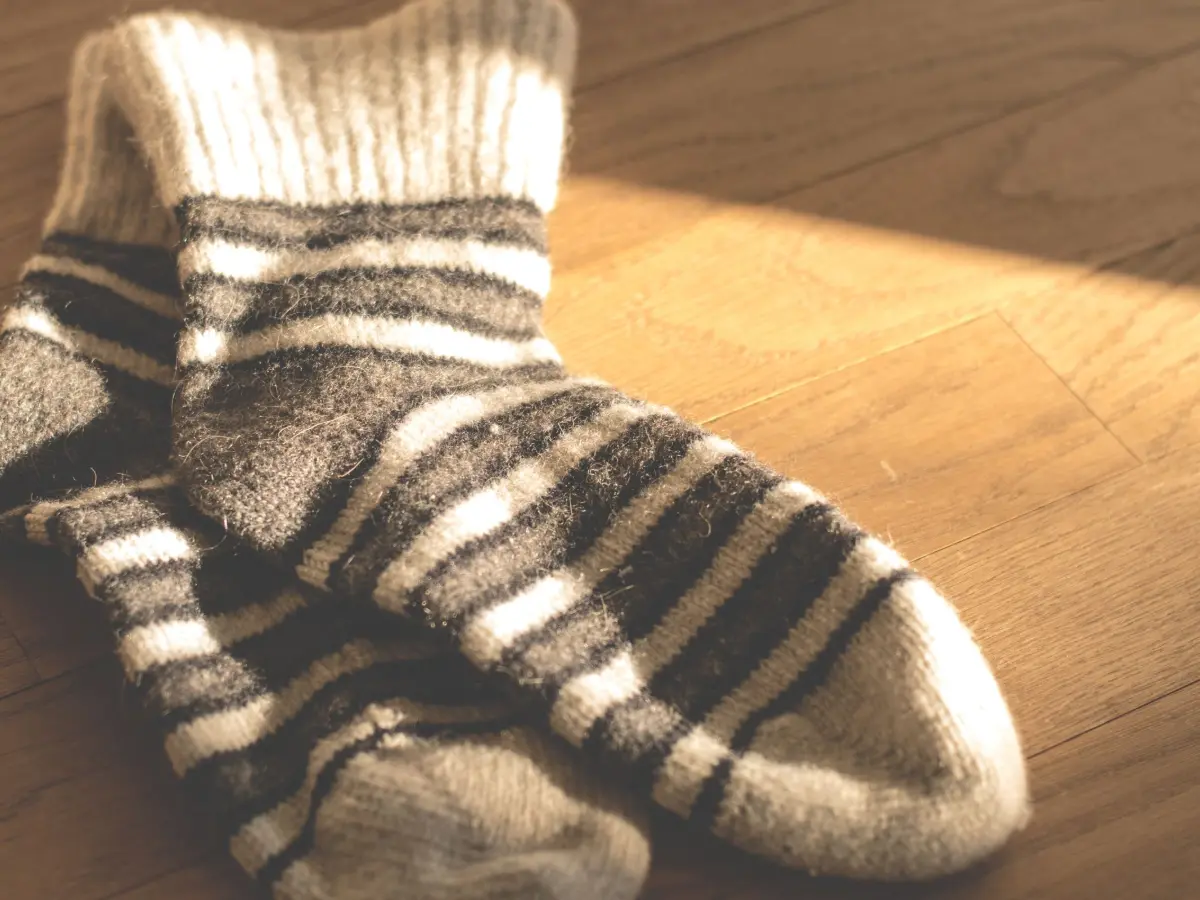
- Wool or merino socks, with no tight bands. Seam-free socks are kinder to numb feet. How to choose socks for neuropathy.
- Keep moving. Walking and calf exercises pump blood into the feet. If walking brings on calf pain that stops when you rest, get your circulation checked.
- Stop smoking. It narrows blood vessels within minutes, and quitting is the single biggest thing you can do for your leg arteries.
- No direct heat on numb feet. No heating pads, hot water bottles, electric blankets or foot soaks. Test bath water with your elbow or a thermometer; 90 to 95°F is safe.
- For a Raynaud’s attack, get somewhere warm and let the toes warm up gradually, and keep them covered in cold weather. Avoid hot water on toes you can’t feel properly.
- Compression socks only after a circulation check. They help swelling, but on narrowed arteries they can do harm. Compression socks and neuropathy.
When to see a doctor
Book an appointment if any of these apply:
- Your feet are cold most of the time and warm socks don’t help.
- Walking brings on calf, thigh or buttock pain that eases when you stop.
- The skin is pale, blue or shiny, hair has stopped growing on your toes, or a sore is slow to heal.
- Your feet are numb, tingling or burning as well as cold.
- You feel cold all over, with tiredness, weight gain or shortness of breath.
- Raynaud’s started after the age of 30, or comes with joint pain, tightening skin or sores on the fingertips. That pattern can point to another condition.
- One foot is consistently colder than the other.
- You have diabetes. Have your foot pulses checked, with an ankle-brachial index or toe pressures if they are weak.
When it is an emergency
- Get emergency care for a foot or leg that suddenly turns cold, pale or blue, whether or not it hurts. That can be a blocked artery, and numbness can hide the pain that would normally come with it.
- Get urgent care for toes that turn white or grayish-yellow, feel unusually firm or waxy and stay numb after time in the cold. That can be frostbite. Get somewhere warm and take off wet socks. Don’t rub the toes, walk on them if you can avoid it, or warm them with a heating pad, fire or radiator. If care will be delayed, warm them in warm, not hot, water, checked with someone else’s hand or a thermometer.
- Go to an emergency department for black skin on a toe, redness that is spreading, or a fever with a foot wound.
Common questions
Why are my feet always cold even when the rest of me is warm?
Usually because the feet are where the body saves heat first: when it wants to protect your core, blood flow to the feet is turned down. Some people simply run cooler at the extremities. Look further if your feet are also pale or bluish, if your calves hurt when you walk, or if your feet feel cold but are warm to someone else’s touch.
Can neuropathy cause cold feet?
Yes. Damaged small nerve fibers can make feet feel cold when they are a normal temperature, and damage to the nerves that control the skin’s blood vessels can make them genuinely cold. Check with someone else’s hand: cold to you but warm to them points to the nerves.
Are cold feet a sign of diabetes?
Not on their own, but diabetes can cause cold feet in two ways, by damaging nerves and by narrowing the leg arteries. If you have diabetes and cold feet, have your pulses checked and your feet examined, and keep heating pads away from your feet.
Are cold feet a sign of poor circulation?
Sometimes. Cold feet that look pale or bluish, with weak pulses, shiny skin, slow-healing sores or calf pain when you walk, point to narrowed arteries. Cold feet that warm up quickly with socks and movement usually don’t.
How do I warm up cold feet safely if they are numb?
Warm the room and the rest of you, wear wool socks, and move. Don’t use heating pads, hot water bottles, electric blankets or hot soaks on feet that can’t feel properly, and test bath water with your elbow or a thermometer.
Why is only one foot cold?
One cold foot is more likely to be a problem with the artery to that leg than a whole-body cause, especially if it is also pale or hurts when you walk, so have it checked. If it turned cold suddenly, get emergency care.
Related reading
Burning and hot feet at night · Small fiber neuropathy · Diabetic neuropathy · Socks for neuropathy · Numb feet · Erythromelalgia · The daily foot check
Sources and further reading: Cleveland Clinic, Cold feet; MedlinePlus, Raynaud phenomenon; NHS, Peripheral arterial disease; NIDDK, Hypothyroidism; NHLBI, Iron-deficiency anemia; NINDS, Peripheral neuropathy; NIDDK, Diabetes and foot problems; Society for Vascular Surgery, Acute limb ischemia; MedlinePlus, Raynaud phenomenon (causes, including medicines); CDC, Preventing frostbite and hypothermia.
This page is general education and is not a diagnosis, a treatment plan, or a substitute for care from your own clinician. Clinical review by Dr. Biernacki is pending; the review date will be shown here once complete.
For our Michigan neighbors
Cold feet that
won’t warm up?
Checking the pulses, the circulation and protective sensation is part of every foot exam, and it is the first step in working out whether the cause is the arteries, the nerves or neither. Dr. Biernacki’s Michigan practice can do that, and coordinate with your primary care clinician for thyroid and blood tests.
Everywhere else, take this page to your own clinician.

Dr. Tom Biernacki, DPM, FACFAS is a double board-certified foot and ankle surgeon (ABFAS and ABPM) and a Fellow of the American College of Foot & Ankle Surgeons. He is the founder of Balance Foot & Ankle in Howell and Bloomfield Township, Michigan, where peripheral neuropathy, diabetic foot risk and loss of protective sensation are part of his weekly clinic. His patient education videos have drawn more than 950,000 subscribers on YouTube. Managing Neuropathy is written by its editorial team under his direction, to put the explanation he gives in the exam room in front of the people who cannot get to one — including when a product is worth buying and when it is not.