Causes
Meralgia paresthetica: symptoms, treatment and exercises
Meralgia paresthetica is a pinched nerve at the front of the hip that makes the outer thigh burn, tingle or go numb. It doesn’t weaken the leg, and for most people it eases within a few months once the pressure comes off.
Written by the Managing Neuropathy editorial team under the direction of Dr. Tom Biernacki, DPM, FACFAS · Clinical review pending · Last updated 5 October 2026
The short answer. Meralgia paresthetica is pressure on the lateral femoral cutaneous nerve, which carries feeling from the skin of the front and outer thigh and leaves the pelvis just inside the bony point at the front of the hip. It causes burning, tingling, numbness or skin that hurts to the touch over the outer thigh, usually on one side and often worse when standing or walking. Tight belts and waistbands, weight gain, pregnancy, diabetes and hip or pelvic surgery are common triggers. Looser clothing, weight loss if needed and simple pain relievers come first, and for most people symptoms ease within a few months; injections, and rarely surgery, are for pain that persists. Leg weakness, symptoms below the knee or numb feet point to a different problem.
What meralgia paresthetica is
The lateral femoral cutaneous nerve starts from the second and third lumbar nerve roots in the lower back, crosses the inside of the pelvis, and leaves it near the anterior superior iliac spine, the bony point you can feel at the front of the hip, passing under the inguinal ligament in the groin. From there it supplies the skin of the front and outer thigh. Its course varies: in some people it passes through the ligament or the sartorius muscle instead of under it.
It is a sensory nerve only, with no branches to muscles. So meralgia paresthetica changes how the skin feels but can’t weaken the leg. Where the nerve bends around the hip bone it can be squeezed from outside, by a belt or waistband, or from inside, by the belly and pelvis.
The condition is also called lateral femoral cutaneous neuropathy, or Bernhardt-Roth syndrome. Sigmund Freud had it, and described his own symptoms in a neurology journal in 1895.
It isn’t rare. Studies in Minnesota and the Netherlands counted 3 to 4 new cases a year for every 10,000 people, most often in middle age.
Symptoms
The typical symptoms, usually on one side:
- Burning, tingling or numbness over the front and outer thigh, from below the hip to just above the knee. Some people feel it reach the outer side of the knee.
- Skin that hurts to the touch. Light pressure, clothing or a phone in a pocket can feel painful or strange.
- Worse with standing, walking or stretching the hip back, and often better sitting with the hip bent. Some people notice it most lying flat in bed.
- A tender spot just inside the bony point at the front of the hip, where the nerve leaves the pelvis.
- Normal strength. The leg muscles work normally, because the nerve has no muscles to weaken.
A patch that stays on the thigh, with no weakness and nothing below the knee, is the pattern that fits. Numbness that starts in both feet and creeps upward is a different problem, usually peripheral neuropathy. What numb feet can mean.
What causes it
Anything that presses on, stretches or injures the nerve near the hip bone. Often no single cause is found. The usual suspects:
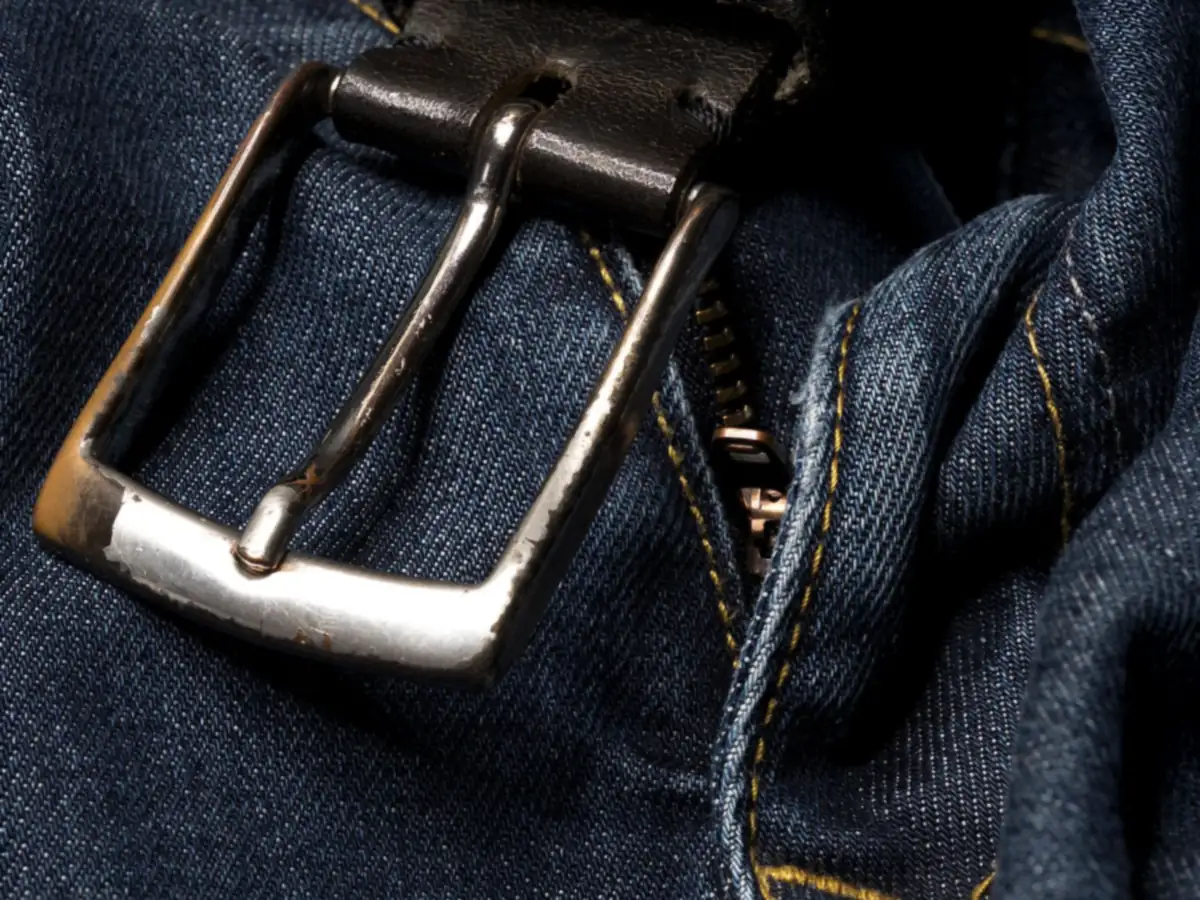
- Tight clothing: belts, waistbands, corsets and tight trousers. Doctors have nicknamed it “jeans disease.”
- Heavy belts and pockets: tool belts, duty belts and heavy items carried in front pockets.
- Weight gain and obesity. A body mass index (BMI) over 30 roughly doubles the risk. In a Minnesota study, people with meralgia had an average BMI of 30.1, against 27.3 in people of the same age and sex without it.
- Pregnancy, as the belly grows. It usually eases after the baby is born.
- Diabetes, which can injure the nerve directly (see below).
- Surgery and injury: scar tissue after an injury or an operation near the groin, hip surgery, taking bone from the hip for a graft, and operations with the body positioned in ways that bend or press on the hip, including lying face down. A seat belt injury in a car crash can do it too.
- Losing a lot of weight, which removes some of the fat that cushions the nerve.
- Fluid in the belly (ascites) and, rarely, a growth in the pelvis pressing on the nerve.
- Other conditions linked to it include an underactive thyroid, alcohol use disorder, lead poisoning, unequal leg lengths and scoliosis.
In a Dutch general-practice study, people with carpal tunnel syndrome, a pinched nerve at the wrist, were also more likely to have it.
Meralgia paresthetica and diabetes
The two are closely linked. In a population study from Olmsted County, Minnesota, published in Neurology in 2011, meralgia affected people with diabetes at a rate of 247 per 100,000 a year, 7 times the rate in the general population (32.6 per 100,000). Of the people with meralgia, 28 percent had diabetes, against 17 percent of controls matched for BMI, and most of them were diagnosed with diabetes after the meralgia. Overall, people with meralgia were twice as likely to develop diabetes.
Blood sugar is among the tests doctors may order when they look for a cause. If you’re diagnosed with meralgia and haven’t had your blood sugar checked recently, it’s reasonable to ask. If you already have diabetes and your feet are numb too, that is a separate nerve problem worth its own check. More on diabetic neuropathy.
Is it meralgia, or something else?
Several conditions can look similar. The clues that tell them apart:
| Condition | Clues |
|---|---|
| Meralgia paresthetica | A burning or numb patch on the front and outer thigh, stopping above the knee; worse standing; no weakness |
| A pinched nerve root in the lower back (lumbar radiculopathy) | Back pain, or pain, tingling or weakness spreading from the back or buttock down the leg. Roots high in the lower back (L2 and L3) can mimic meralgia closely |
| Femoral neuropathy | Weakness straightening the knee, a knee that buckles, especially going down stairs, an abnormal knee reflex, and numbness or tingling in the thigh, knee or leg |
| Proximal diabetic neuropathy (diabetic amyotrophy) | Severe pain in the buttock, hip or thigh, with weak, shrinking thigh muscles and trouble rising from a chair, usually on one side |
| Shingles | Pain, itching or tingling on one side, followed several days later by a rash, often in a band |
| Peripheral neuropathy | Starts in both feet, at the toes, and creeps upward over months or years |
Muscle trigger points around the hip and buttock, and some groin and pelvic problems, can also cause thigh pain. Radiculopathy or neuropathy: how to tell.
How it’s diagnosed
Usually from your description and an examination: a map of the numb or tender skin, pressure over the spot near the hip bone, and a check of strength and reflexes, which should be normal. Tests mainly rule out the look-alikes:
- Blood tests, such as blood sugar, thyroid hormones, B vitamins, lead and a blood count, for other causes of nerve trouble.
- Imaging, such as X-rays, CT or MRI, when another cause needs to be ruled out.
- Nerve tests: a nerve conduction study and EMG. The thigh nerve is technically hard to test, especially in people with more body fat, so these tests help most in looking for other problems.
- Ultrasound, which can show a swollen nerve and guide an injection.
- A diagnostic nerve block: numbing medicine injected near the hip bone. If the shot eases the pain, that can confirm the diagnosis.
A primary care clinician can usually make the diagnosis. A neurologist or a physical medicine and rehabilitation doctor can help when the picture is unclear.
Treatment, step by step
Treatment starts with whatever is pressing on the nerve, and steps up only if symptoms persist. The evidence behind each step is thin: a Cochrane review found no randomized trials of any treatment, and a 2023 review found only two small ones since, so most of the figures below come from case series.
Looser waistbands and belts, nothing heavy on the belt or in front pockets, weight loss if you carry extra weight, ice, and acetaminophen or ibuprofen. Mayo Clinic says most people need no other treatment, because symptoms ease in a few months. Estimates of how many people improve with this kind of care range from up to 70 percent (a 2023 review) to about 85 percent (Cleveland Clinic).
Options include gabapentin or pregabalin, a tricyclic antidepressant, duloxetine, older seizure medicines such as carbamazepine or phenytoin, and patches or creams with lidocaine or capsaicin. How nerve pain medicines compare.
A local anesthetic, often with a corticosteroid, placed where the nerve leaves the pelvis, ideally guided by ultrasound. It helps confirm the diagnosis as well as treat it. Short-term relief is common; lasting freedom from pain is not.
A needle delivers bursts of radiofrequency current to the nerve without heating the tissue above 42 °C. In two small case series about two-thirds of people became symptom-free, which is too little evidence to recommend it routinely.
Decompression frees the nerve without cutting it, so feeling in the thigh is kept or may recover. Neurectomy cuts the nerve, which leaves that patch of skin permanently numb.
How well injections work. In two retrospective studies, 90 to 91 percent of people had short-term relief, and a small randomized trial of 54 people found injection worked better than a TENS unit or a placebo, although a second small trial, of 20 people, found an injection of steroid and numbing medicine did no better than a saltwater placebo. But a 2021 pooled analysis of the published studies found only 22 percent of people completely free of pain after an injection. The main side effect is a brief weakness of the thigh muscle that straightens the knee, with a risk of falling, in about 5 percent of people; it wears off within 3 hours.
How well surgery works. In a pooled analysis of the published series, 85 percent of people were pain-free after neurectomy and 63 percent after decompression, and repeat operations were less common after neurectomy. The Cochrane review’s older studies reported improvement in 88 percent after decompression (264 of 300) and 94 percent after neurectomy (45 of 48). Complications include a collection of blood needing a second operation in about 5 to 7 percent, and wound infection in about 2 percent. Without randomized trials, it’s hard to say how much of the improvement would have come anyway.
Exercises and stretches
No trial has tested exercises for meralgia paresthetica; the published reports are mostly case reports of single patients. Exercise still has a place: losing extra weight takes pressure off the nerve, and Mayo Clinic suggests a physical therapist can design a program “to strengthen the back, neck and stomach muscles and relieve pressure on the nerve.”
Gentle core and hip moves of the kind such programs use:
- Glute bridge. Lie on your back with knees bent and feet flat. Squeeze your buttocks and lift your hips until your body is straight from shoulders to knees, and no higher. Hold for 3 seconds and lower slowly. Repeat 10 times.
- Pelvic tilt. Lie on your back with knees bent. Tighten your stomach and gently press your lower back into the floor. Hold for 5 seconds. Repeat 10 times.
- Front plank, on your forearms, starting from your knees. Keep your back straight and hold for 15 to 30 seconds, building up over weeks.
- Walking, swimming or a stationary bike most days, for fitness and weight.
Go easy on stretches that pull the hip back, such as deep lunges and the cobra pose, unless a clinician has built them into your program. Extending the hip stretches the nerve and can bring on symptoms. If a stretch makes the tingling spread or last longer, drop it. If exercise ever leaves the leg weak, stop and get checked.
How long it lasts
For most people, months rather than years. Mayo Clinic says symptoms usually ease in a few months, and Cleveland Clinic says about 85 percent of people recover with conservative treatment. In one study from 1938, 20 of 29 people (69 percent) improved with no treatment at all.
Meralgia caused by surgery does especially well: in three studies, 99 of 102 people recovered completely, and Cleveland Clinic says these cases usually improve within three months. Meralgia that starts in pregnancy usually eases after delivery.
When to get help urgently
- Go to an emergency department, or call 911, for numbness around or under the genitals or around the bottom, new trouble peeing or controlling your bladder or bowels, or weakness or numbness in both legs that is severe or getting worse: possible pressure on the nerves at the base of the spine.
- Call 911 for sudden numbness or weakness of the face, an arm or a leg, especially on one side, or sudden trouble speaking: possible stroke.
- Get seen the same day for new weakness in the leg, a knee that gives way, or severe thigh pain with shrinking thigh muscles, especially if you have diabetes.
- See a clinician within a day or two if pain or tingling on one side is followed by a rash (possible shingles): antiviral medicine works best when started within about 3 days.
- See a clinician soon if the numbness spreads below the knee or into the foot, or if it affects both thighs.
- Book a routine visit if symptoms last more than two months despite looser clothing, or keep coming back.
Common questions
How long does meralgia paresthetica last?
Usually a few months. Mayo Clinic says most people need no treatment because symptoms ease in a few months, and Cleveland Clinic says about 85 percent recover with conservative care. Cases caused by surgery usually recover completely, and cases that start in pregnancy usually ease after delivery. If symptoms last more than two months or the pain is severe, medicine or an injection is the next step.
What is the fastest way to relieve meralgia paresthetica?
Take the pressure off the nerve: loosen or remove the belt, wear looser waistbands, and empty heavy front pockets. Ice and over-the-counter pain relievers help in the meantime, and sitting with the hip bent often eases it. For severe pain, an injection near the hip bone often gives quick relief, though it often wears off.
What makes meralgia paresthetica worse?
Pressure and stretch on the nerve: tight belts, waistbands and tool belts, standing or walking for long periods, positions that extend the hip, such as lying flat or deep lunges, and weight gain. Some people notice it most at night, lying on their back.
Can meralgia paresthetica cause weakness or numbness in the foot?
No. The nerve only carries feeling from the skin of the thigh, so it can’t weaken the leg, and its area stops above the knee or at its outer side. Weakness, a knee that gives way, or numbness below the knee or in the feet points to another problem, such as a pinched nerve root in the back, femoral neuropathy or peripheral neuropathy, and needs a check.
Is meralgia paresthetica serious?
On its own it is not a threat to the leg: it doesn’t affect strength, and most cases settle. It matters for two reasons. Similar symptoms can come from the spine or other nerves, so a new numb patch deserves an examination. And meralgia is linked to diabetes: in a Minnesota study, people with meralgia were twice as likely to develop it, so a blood sugar test is worth asking about.
Related reading
Radiculopathy or neuropathy? · Peroneal neuropathy · Tarsal tunnel syndrome · Diabetic neuropathy · Neuropathic pain · Types of neuropathy
Sources and further reading: Mayo Clinic, Meralgia paresthetica: symptoms and causes and diagnosis and treatment, 2026. Cleveland Clinic, Meralgia paresthetica, 2023. Scholz C et al., Meralgia paresthetica: relevance, diagnosis, and treatment, Deutsches Ärzteblatt International, 2023, for anatomy, risk factors, clinical features, tests, the pooled results for injection and surgery, pulsed radiofrequency, surgical complications, and Freud’s case (German edition). Khalil N, Nicotra A, Rakowicz W, Treatment for meralgia paraesthetica, Cochrane review, 2012. Kloosterziel ME et al., Meralgia paresthetica: nerve stimulator-guided injection with methylprednisolone/lidocaine, a double-blind randomized placebo-controlled study, Muscle & Nerve, 2020. Parisi TJ et al., Meralgia paresthetica: relation to obesity, advanced age, and diabetes mellitus, Neurology, 2011. van Slobbe AM et al., Incidence rates and determinants in meralgia paresthetica in general practice, Journal of Neurology, 2004. Roecker CB et al., Chiropractic management of bilateral meralgia paresthetica: a case report, Journal of the Canadian Chiropractic Association, 2023. MedlinePlus, Femoral nerve dysfunction, 2025. Mayo Clinic, Diabetic neuropathy, 2025, on proximal neuropathy. CDC, Shingles symptoms and complications, 2024, and Clinical overview of shingles, 2024, on antiviral timing. NINDS, peripheral neuropathy. Warning signs: NHS, sciatica, on symptoms that need emergency care; CDC, stroke signs and symptoms.
This page is general education and is not a diagnosis, a treatment plan, or a substitute for care from your own clinician. Clinical review by Dr. Biernacki is pending; the review date will be shown here once complete.
For our Michigan neighbors
A numb thigh,
and numb feet too?
Meralgia itself is usually managed by a primary care clinician or a neurologist. If your feet are also numb, burning or tingling, that is a separate problem worth an examination. Dr. Biernacki’s Michigan practice can start there.
Everywhere else, take this page to your own clinician.

Dr. Tom Biernacki, DPM, FACFAS is a double board-certified foot and ankle surgeon (ABFAS and ABPM) and a Fellow of the American College of Foot & Ankle Surgeons. He is the founder of Balance Foot & Ankle in Howell and Bloomfield Township, Michigan, where peripheral neuropathy, diabetic foot risk and loss of protective sensation are part of his weekly clinic. His patient education videos have drawn more than 950,000 subscribers on YouTube. Managing Neuropathy is written by its editorial team under his direction, to put the explanation he gives in the exam room in front of the people who cannot get to one — including when a product is worth buying and when it is not.