Diagnosis
The monofilament test: the 10-gram foot exam, explained
A thin nylon filament, pressed against the sole until it bends, answers one question that matters more than any other in a numb foot: can you still feel enough to be warned before an injury becomes an ulcer?
Written by the Managing Neuropathy editorial team under the direction of Dr. Tom Biernacki, DPM, FACFAS · Clinical review pending · Last updated 24 September 2026
The short answer. The monofilament test checks protective sensation: the level of feeling you need to notice a blister, a stone in your shoe or a rubbing seam in time. It takes about a minute, involves nothing sharp, and the American Diabetes Association recommends it for everyone with diabetes at least once a year. Missing spots doesn’t diagnose the cause of your numbness. It does mark a foot that needs protecting, and changes how often your feet should be checked.
What the test checks
The filament is calibrated to buckle at a pressure of 10 grams. If you can’t feel that at key points on the sole, you have what clinicians call loss of protective sensation. That is the threshold below which everyday injuries stop hurting enough to be noticed. A shoe that rubs, a stone in a sock or a small burn goes unfelt, and the damage keeps building. That is how most foot ulcers in people with neuropathy begin. It is why the ADA describes annual monofilament testing as the way to identify feet at risk for ulceration and amputation.
It is a screening test, not a full nerve examination. A normal result doesn’t rule out neuropathy, particularly the small-fiber kind that causes burning with little numbness. An abnormal result doesn’t say why the nerves are damaged. Small fiber neuropathy is covered here.
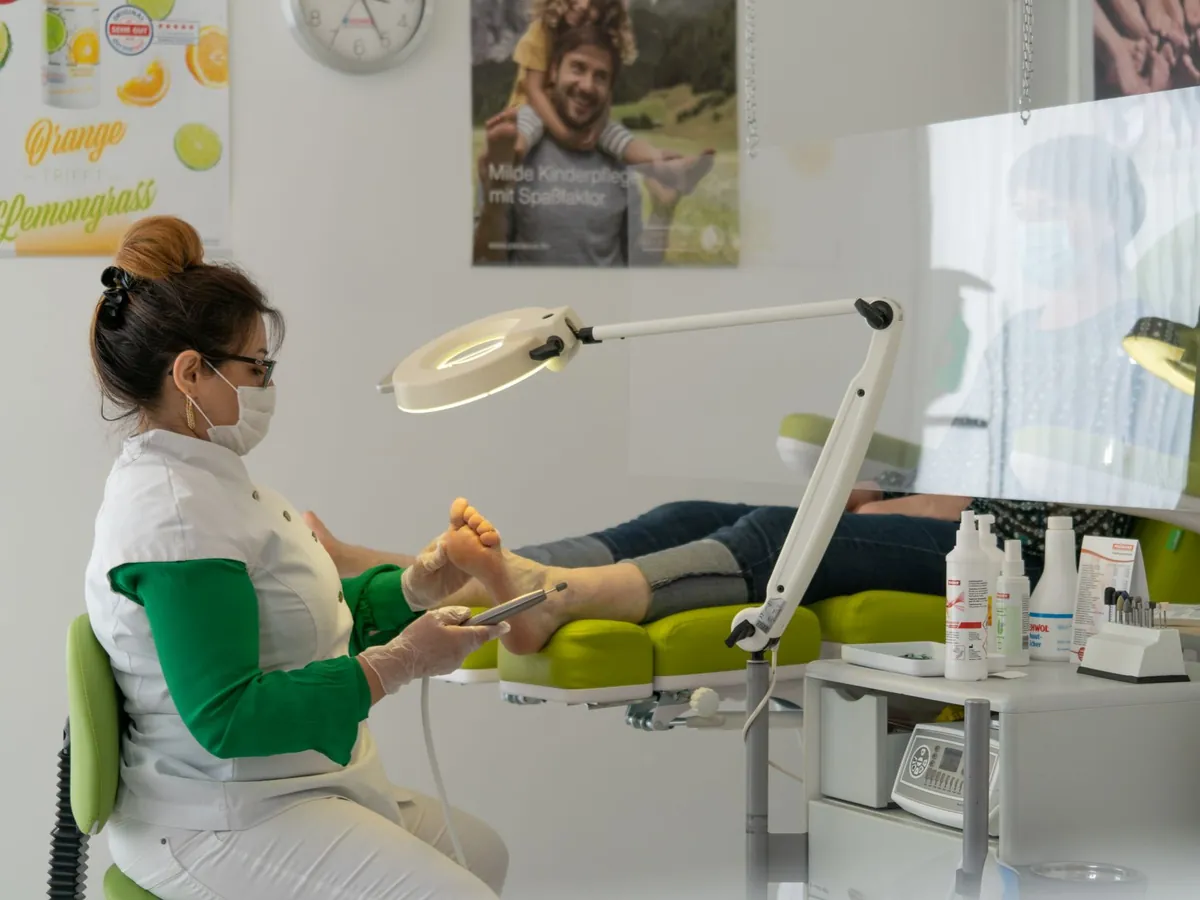
How the 10-gram exam is done, step by step
The International Working Group on the Diabetic Foot (IWGDF) sets out the standard method. A good examiner follows it closely, because shortcuts give misleading results.
The filament is touched to your hand or arm so you know what it feels like.
You look away or close your eyes, so you can’t tell when or where it touches.
Straight onto the skin, just hard enough to buckle, for about two seconds in total. It goes on healthy skin, never on a callus, scar or wound.
Usually spots on the sole such as the underside of the big toe and the ball of the foot. You are asked whether you feel it, and where.
Each site is tested twice, mixed with at least one “mock” touch where nothing is applied. Sensation counts as present if you answer two of the three correctly.
The whole thing takes a minute or two. It doesn’t hurt, and there is nothing to prepare, though clean, uncovered feet make it easier.
What a missed spot means
If you miss sites, your feet have lost protective sensation. On its own, that is not an emergency. It changes the rules for looking after your feet:
- Your feet need checking at every visit. That is the ADA’s recommendation for anyone with sensory loss, not just once a year.
- You need to check them yourself, daily. Your eyes now do the job your nerves used to. The daily foot check takes two minutes.
- Footwear becomes protective equipment. Shoes and socks at all times, including indoors, with room for the toes and no seams that rub. What to look for is here.
- Heat is dangerous. No heating pads, hot water bottles or hot soaks, because a foot that can’t feel 10 grams can’t judge temperature either.
- You can keep moving. Loss of protective sensation does not mean giving up walking or exercise. It means doing both in proper shoes and checking your feet afterward. Safe exercises for numb feet are here.
- The cause still needs finding, if nobody has looked for it. Diabetes is the commonest, but the ADA lists others worth ruling out: low vitamin B12 (especially with metformin), alcohol, thyroid and kidney disease, and some medicines.
How often you should have it
For people with diabetes, the ADA’s 2026 Standards of Care recommend:
- checking for peripheral neuropathy from the diagnosis of type 2 diabetes, and from five years after the diagnosis of type 1, then at least once a year;
- a comprehensive foot examination at least annually, using the 10-gram monofilament or the Ipswich touch test plus at least one other test of sensation (pinprick, temperature or vibration), along with the skin, foot shape and the pulses;
- inspection at every visit once there is sensory loss, a previous ulcer or an amputation.
Without diabetes, there is no fixed schedule. If your feet are numb or tingly, ask for the test at your next appointment.
A 30-second check you can do at home
The Ipswich touch test was designed in England as a quick bedside check, and in its original study it agreed closely with the monofilament. You need a helper:
- Lie or sit with your eyes closed and your feet bare.
- Your helper rests the tip of their index finger, lightly, for one to two seconds on the tip of your big toe, your third toe and your little toe, on each foot. That makes six touches. They should touch, not press, poke or tap.
- Say “yes” each time you feel a touch.
Missing two or more of the six suggests loss of protective sensation. It isn’t a diagnosis, and a normal result doesn’t replace an examination. But a missed touch is a good reason to book one, and to start checking your feet daily now.
The other tests you may have
| Test | What it checks |
|---|---|
| 128-Hz tuning fork, on the big toe joint | Vibration sense, carried by the large nerve fibers. Often the first sensation to fade. |
| Pinprick, or a warm and cool object | Pain and temperature sense, carried by the small fibers that cause burning pain. |
| Ankle reflexes | Often reduced or absent in length-dependent neuropathy. |
| Blood tests | The cause: glucose and HbA1c, vitamin B12, thyroid and kidney function, among others. |
| Nerve conduction studies and EMG | Electrical testing of the nerves and muscles. The ADA notes these are rarely needed when the picture is typical, and are used when symptoms came on quickly, affect one side, or involve weakness. |
Common questions
Does the monofilament test hurt?
No. The filament is soft nylon that buckles at 10 grams of pressure, about the weight of two nickels. It feels like a light press, and nothing breaks the skin.
What is a normal monofilament test result?
Feeling the filament correctly at each tested site, meaning two out of three correct answers at every site, including the mock touches. A normal result means you still have protective sensation. It doesn’t rule out early or small-fiber neuropathy.
Can the monofilament test diagnose neuropathy?
It identifies loss of protective sensation, which is the part of neuropathy that leads to ulcers. Diagnosing neuropathy and its cause takes a history, other sensory tests and usually blood work.
Who does the monofilament test?
Podiatrists, primary care clinicians, diabetes educators and endocrinologists all use it. If you have diabetes and nobody has tested your feet this year, ask. It takes a minute.
Can I buy a monofilament and test myself?
The filaments are inexpensive, but testing your own feet is unreliable, because you can see and anticipate the touch. The Ipswich touch test with a helper is the better home check, and neither replaces an examination.
Related reading
The daily foot check · Diabetic neuropathy · Which doctor treats neuropathy · Numb toes: reading the pattern · Questions to take to your appointment
Sources and further reading: American Diabetes Association Standards of Care in Diabetes—2026, section 12. It covers screening timing, annual 10-gram monofilament testing, the comprehensive foot examination, inspection at every visit after sensory loss, and other causes of neuropathy. International Working Group on the Diabetic Foot, practical guidelines, on the monofilament method, mock applications and the two-out-of-three rule. Rayman G et al., The Ipswich Touch Test, Diabetes Care, 2011. NIDDK, diabetes and foot problems.
This page is general education and is not a diagnosis or a treatment plan. Clinical review by Dr. Biernacki is pending; the review date will be shown here once complete.
For our Michigan neighbors
When were your feet
last tested?
The monofilament test takes a minute and tells you how much protection your feet still have. Dr. Biernacki’s Michigan practice can check it, along with circulation and the skin.
Everywhere else, take this page to your own clinician.

Dr. Tom Biernacki, DPM, FACFAS is a double board-certified foot and ankle surgeon (ABFAS and ABPM) and a Fellow of the American College of Foot & Ankle Surgeons. He is the founder of Balance Foot & Ankle in Howell and Bloomfield Township, Michigan, where peripheral neuropathy, diabetic foot risk and loss of protective sensation are part of his weekly clinic. His patient education videos have drawn more than 950,000 subscribers on YouTube. Managing Neuropathy is written by its editorial team under his direction, to put the explanation he gives in the exam room in front of the people who cannot get to one — including when a product is worth buying and when it is not.