Treatment literacy
Home remedies for neuropathy in the legs and feet: what helps, what doesn’t, and whether it can be cured
Some neuropathies genuinely improve — and a few reverse completely — when the right cause is found. Understanding which kind you have is the difference between real hope and an expensive disappointment.
Written by the Managing Neuropathy editorial team under the direction of Dr. Tom Biernacki, DPM, FACFAS · Clinical review pending · Last updated 19 September 2026
The short answer. Whether neuropathy improves depends almost entirely on its cause. Several causes are correctable and the nerves can recover. Long-standing diabetic nerve damage usually does not reverse — but its progression can be slowed, its symptoms reduced, and its serious complications largely prevented. Movement and glucose control do more than anything you can buy.
First: which kind do you have?
“Neuropathy” is a description of damaged nerves, not a single disease, and this is the question that determines everything else. If nobody has looked for a cause in your case, that is the most valuable thing you can pursue — considerably more valuable than any remedy on this page.
Causes where real improvement is possible
- Vitamin B12 deficiency. A treatable cause with a simple blood test. Worth checking especially if you take metformin, take long-term acid-reducing medication, follow a vegan diet, or have had bowel surgery.
- Vitamin B6 excess. Too much B6 causes neuropathy, and it is in many “nerve support” supplements. Stopping the excess often improves it.
- Medication-induced neuropathy. Some drugs cause it. Where a substitution is possible, symptoms may settle.
- Alcohol-related neuropathy. Often improves with sustained reduction, alongside nutritional correction.
- Thyroid disease. Treating it can improve the nerve symptoms.
- Nerve compression or entrapment. A pinched nerve is a mechanical problem with a mechanical solution, and it is not the same thing as a diffuse neuropathy.
- Prediabetes and early diabetic neuropathy. Caught early, glucose control can slow and sometimes partially improve it.
That list is genuinely hopeful, and it is the honest reason to push for a proper diagnostic workup rather than starting a remedy.
Where expectations should be realistic
Established diabetic peripheral neuropathy, chemotherapy-induced neuropathy, and hereditary neuropathies do not usually reverse. Nerve fibers that have died do not grow back on any timescale that helps. What is achievable — and it is a great deal — is slowing progression, reducing pain, improving balance and sleep, and preventing the ulcers and infections that cause the actual harm.
What genuinely helps: natural remedies with real evidence
Glucose control, if you have diabetes
This is the intervention with the strongest evidence for slowing progression, and nothing sold as a remedy competes with it. It is unglamorous and it is the answer.
Movement — the most underrated item on this page
Regular physical activity has genuine evidence behind it for neuropathy symptoms and quality of life, and it helps glucose control at the same time. It is free, and most people do less of it than they could.
A reasonable approach: regular walking within your capability; balance work, because the nerves that report your foot’s position are the damaged ones and falls are a serious risk; simple leg and foot strengthening; and gentle calf and foot stretching for the stiffness that comes with reduced movement.
Two safety points. Do balance exercises holding a stable surface — a kitchen counter, not a chair that slides — and ideally with someone nearby at first. And check your feet after any new activity: increased walking is good for you and also increases the load on skin that cannot report a blister forming.
If your balance is noticeably affected, ask for a referral to physical therapy rather than improvising. A supervised program is safer and generally more effective than exercises picked off a web page — including this one.
Which movements, and which to skip when the feet are numb, are set out in our guide to neuropathy exercises.
The rest of the basics
Stopping smoking improves circulation to the nerves. Reducing alcohol matters, and matters enormously if alcohol is the cause. Weight loss where relevant helps glucose control. And protecting your feet daily — inspection, well-fitting shoes, moisturising, prompt attention to any break in the skin — prevents the complications that turn manageable neuropathy into a serious event.
For what to eat, and which foods and drinks are worth cutting back, there is a separate guide.
Home remedies for nerve pain in the feet, examined honestly
| Remedy | Assessment |
|---|---|
| Epsom salt soaks and foot baths | Generally advised against if you have diabetes or reduced sensation. Soaking softens and macerates skin, making it more vulnerable, and you cannot reliably judge water temperature with a numb foot. Standard diabetes foot-care guidance says not to soak. There is no evidence magnesium is absorbed through skin in useful amounts. |
| Heat — pads, hot water bottles, hot soaks | Actively unsafe on feet with reduced sensation. Burns occur at temperatures that feel mild or feel like nothing. This is one of the most common preventable injuries we see. |
| Capsaicin cream | Real evidence, modest effect, needs consistent use over weeks. Expect burning at first. Not on broken skin. |
| Gentle massage | Reasonable for comfort. Your hands can feel what your feet cannot, which is an advantage over a machine. Not a treatment. |
| Turmeric, apple cider vinegar, essential oils | No meaningful human evidence in neuropathy. Turmeric can interact with anticoagulants. |
| Cold packs | May briefly dull burning. Same caution as heat: use a barrier and keep it brief, since you cannot feel a cold injury either. |
| Alpha-lipoic acid | The most-studied supplement here, with mixed results and the best data from intravenous use. Worth asking your clinician about; not a cure. |
Two options people often ask about next have their own evidence reviews: red light therapy and acupuncture.
How to treat nerve pain in the foot at home
For the nights when burning or shooting pain flares, a short routine does more than any single product.
A few minutes of gentle walking or ankle circles often settles nerve pain better than lying still, and regular activity that is easy on the feet, such as walking, swimming, cycling or stretching, reduces symptoms over time.
If cooling helps, use something cool rather than icy, wrapped in a cloth, for a few minutes, then check the skin. Never use a heating pad or hot water bottle on your feet; a numb foot cannot warn you it is burning.
Capsaicin cream, applied regularly for several weeks, can quiet the nerves that send pain messages, and a lidocaine cream or patch can take the edge off a flare. Which creams work, and how to use them.
Use warm, not hot, water, checked with your elbow or a thermometer (90 to 95°F is safe), keep it brief rather than soaking, and dry carefully between the toes.
A long day on your feet, tight shoes, alcohol and poor sleep are common triggers. A pattern in your notes is often the most useful thing to bring to an appointment.
Nerve pain does not usually respond to ordinary painkillers such as paracetamol (acetaminophen) or ibuprofen. If pain is stopping you sleeping, the medicines designed for nerve pain are worth a conversation. The four families are explained here.
Why “how I cured my neuropathy” stories mislead
These stories are everywhere, and most are told sincerely. There are three ordinary explanations that have nothing to do with the product being credited.
Someone with B12 deficiency who starts a B-complex genuinely improves — because of the deficiency correction, not the blend. That is a real cure of a real cause, wrongly attributed.
Neuropathy has good weeks and bad weeks. Anything started during a bad week tends to be credited for the good one that follows.
People who buy a remedy often also start walking, sleeping better, and paying attention to their glucose. The remedy gets the credit for the whole package.
Add that dissatisfied buyers rarely write follow-ups, and testimonial pages select heavily for the people who improved. None of that makes the storyteller dishonest. It does make the story useless as evidence.
A clear rule: any product promising to reverse, cure, or regenerate nerves is making a claim no consumer product supports. Treat it as a reason for scepticism rather than hope.
What to actually do next
Ask whether a cause has been identified in your case, and whether B12 has been checked. Bring every supplement bottle to that appointment — the B6 content matters. Ask about a physical therapy referral if balance is a problem. Get your feet examined, including sensation testing. And start the daily foot check, which is free and prevents more harm than anything else on this page.
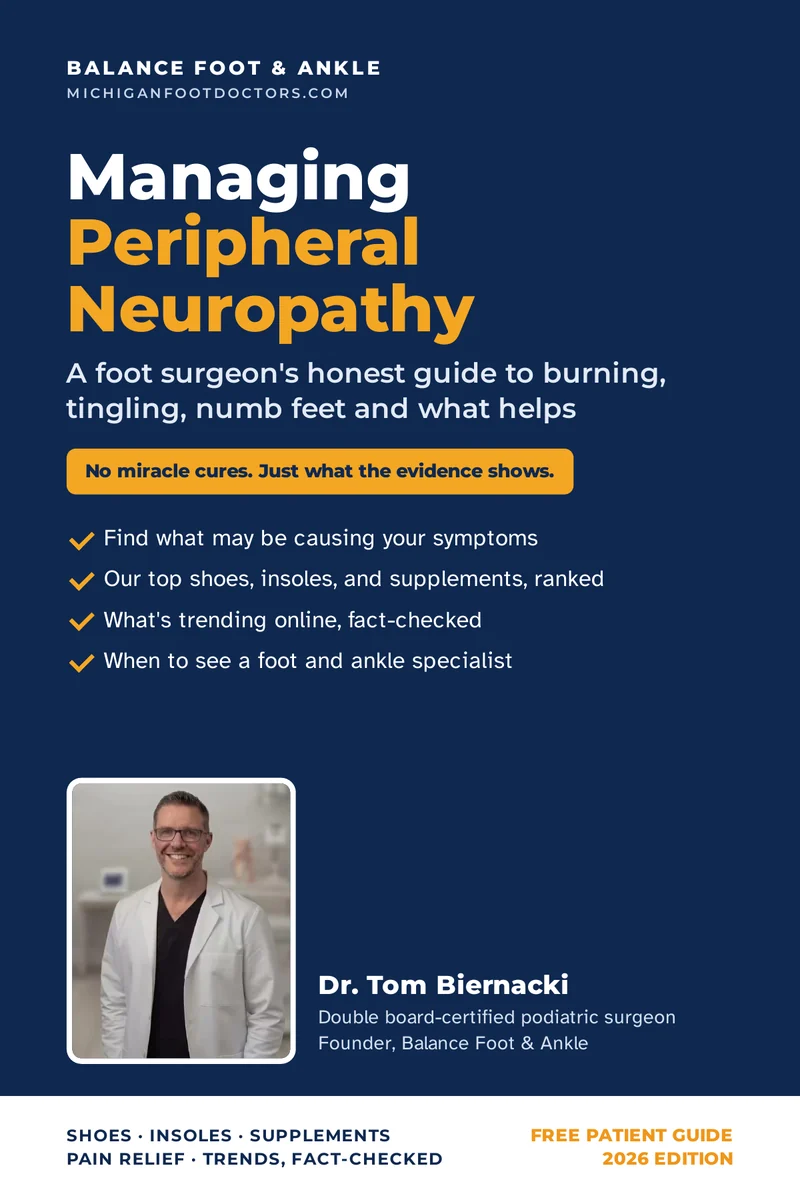
Free guide: Managing Peripheral Neuropathy
Dr. Tom Biernacki’s 33-page patient guide: the tests to ask about, shoes and supplements ranked by the evidence, 16 online trends fact-checked, and a 7-day tracker. No sign-up needed.
Get the free guideWhen home treatment isn’t enough
Get seen promptly for any of these: an open sore or blister that is not healing; redness, warmth, swelling or drainage; any wound at all if you have diabetes; rapidly worsening numbness or weakness; a foot that has changed shape or become warm and swollen without injury; or new weakness climbing stairs or lifting your foot.
Common questions
Can neuropathy in the feet be reversed at home?
Only when the cause can be corrected, and that usually takes a diagnosis rather than a remedy: a B12 deficiency, too much B6 from supplements, alcohol, or an underactive thyroid. For established diabetic neuropathy, home measures slow progression and ease symptoms but do not regrow lost nerve fibers. Here is what recovery realistically looks like.
Does soaking your feet help neuropathy?
Not reliably, and it carries real risk. Diabetes foot-care guidance advises against soaking, because it dries and weakens the skin, and a numb foot cannot judge water temperature, which is how scalds happen. If warm water relaxes you, keep it brief and test the temperature first.
What is the fastest home remedy for nerve pain in the feet?
For quick relief during a flare, gentle movement, brief cooling through a cloth, and a lidocaine cream or patch act fastest. Capsaicin takes weeks of regular use. None of these changes the underlying nerve damage, and if flares are frequent, a prescription nerve-pain medicine usually does more than anything over the counter.
Is walking good for neuropathy in the feet?
For most people, yes. Regular walking helps symptoms, balance and glucose control. Wear well-fitting shoes and socks, build up gradually, and check your feet afterward, because more walking means more load on skin that cannot report a blister. If your balance is poor, start with supervised exercise.
Related reading
Supplements for neuropathy · Neuropathy creams · Daily foot care · Treatment options · Can neuropathy be reversed? · How to stop numbness
Sources and further reading: National Institute of Diabetes and Digestive and Kidney Diseases (NIDDK), peripheral neuropathy and diabetes foot-care guidance, including advice against soaking the feet and applying heat. American Diabetes Association Standards of Care, neuropathy section, including guidance on glycaemic control to slow progression and on B12 monitoring with metformin. National Institutes of Health Office of Dietary Supplements, vitamin B6 upper intake level. NIDDK, diabetes and foot problems, on water temperature (90 to 95°F), not soaking, avoiding heating pads, and activities that are easy on the feet. NHS, peripheral neuropathy treatment, on why common painkillers rarely help nerve pain, the medicines used instead, and capsaicin.
This page is general education and is not a diagnosis, a treatment plan, or advice to start or stop any medicine or supplement. Clinical review by Dr. Biernacki is pending; the review date will be shown here once complete.
For our Michigan neighbors
Has anyone looked
for the cause?
That question is worth an examination. Dr. Biernacki’s Michigan practice can test sensation, assess circulation, and say what is worth pursuing.
Everywhere else, take this page to your own clinician.

Dr. Tom Biernacki, DPM, FACFAS is a double board-certified foot and ankle surgeon (ABFAS and ABPM) and a Fellow of the American College of Foot & Ankle Surgeons. He is the founder of Balance Foot & Ankle in Howell and Bloomfield Township, Michigan, where peripheral neuropathy, diabetic foot risk and loss of protective sensation are part of his weekly clinic. His patient education videos have drawn more than 950,000 subscribers on YouTube. Managing Neuropathy is written by its editorial team under his direction, to put the explanation he gives in the exam room in front of the people who cannot get to one — including when a product is worth buying and when it is not.