Causes
Charcot-Marie-Tooth disease: symptoms, feet and treatment
Charcot-Marie-Tooth disease is the most common inherited neuropathy. It usually shows first in the feet, as high arches, curled toes and weak ankles, and it worsens slowly over years.
Written by the Managing Neuropathy editorial team under the direction of Dr. Tom Biernacki, DPM, FACFAS · Clinical review pending · Last updated 27 September 2026
The short answer. Charcot-Marie-Tooth disease (CMT) is a group of inherited conditions that damage the nerves to the feet, the legs and, later, the hands. By the most-quoted estimate it affects about 1 in 2,500 people, though some studies find it rarer. Weakness and numbness creep up from the feet over years, often with high arches, curled toes, ankle sprains and tripping. There is no cure yet, but stretching, orthoses, braces and, when needed, foot surgery help with walking, and life expectancy is usually normal.
What Charcot-Marie-Tooth disease is
CMT is a group of genetic conditions that damage the peripheral nerves: motor nerves, which work the muscles, and sensory nerves, which carry touch, temperature and position sense. The longest nerves go first, so the feet are affected before the hands. More than 100 genes are involved. CMT is also called hereditary motor and sensory neuropathy (HMSN).
How common it is. CMT affects about 1 in 2,500 people, the estimate used by NIH’s MedlinePlus Genetics and a 2026 expert review. Estimates vary by region, and a 2023 meta-analysis of 31 studies put the figure for all ages at 17.69 per 100,000, about 1 in 5,650. The leading cause of neuropathy in the US is diabetes.
The name honors the three doctors who described it in 1886: Charcot, Marie and Tooth. It is not Charcot foot, a breakdown of bones and joints in a numb foot, though that has occasionally been reported in CMT. Where CMT fits among the types of neuropathy.
The types, and how CMT runs in families
CMT is sorted into types by the part of the nerve that is damaged and by how it is inherited. Four genes, PMP22, MPZ, MFN2 and GJB1, account for 80 to 90 percent of the causes found.
| Type | Key facts | Inheritance | Share of cases |
|---|---|---|---|
| CMT1 (demyelinating) | Damages myelin, the insulation around nerve fibers. CMT1A, from an extra copy of the PMP22 gene, is the most common type. | Dominant | At least half |
| CMT2 (axonal) | Damages the axon, the nerve fiber itself. MFN2 is the most common gene. | Mostly dominant | 10 to 36 percent, by study |
| CMTX | The second most common form after CMT1A, usually from the GJB1 gene. | X-linked | 10 to 15 percent |
| CMT4 | Rare and often severe, usually starting in childhood; many lose the ability to walk by their teens. | Recessive | A small percentage |
A related condition, hereditary neuropathy with liability to pressure palsies (HNPP), comes from losing one copy of PMP22 and causes bouts of numbness and weakness after pressure on a nerve, often at the wrist, elbow or knee, that usually recover. Pressure on the nerve at the knee.
- Dominant. Each child of an affected parent has a 50 percent chance of inheriting it, as does each brother and sister when a parent has it.
- X-linked. An affected father passes the gene change to all his daughters and none of his sons; a mother who carries it passes it to each child with a 50 percent chance. Women often have milder symptoms or none.
- Recessive. Both parents are usually healthy carriers, and each of their children has a 25 percent chance of being affected.
About 10 percent of cases start with a new genetic change, so there may be no family history. A genetic counselor can explain what a result means for your relatives and for family planning.
Symptoms, feet first
Symptoms usually begin between childhood and early adulthood: ages 5 to 15, says the NHS, or the teens and early adulthood, say NINDS and Mayo Clinic. Some people notice nothing until midlife or later.
High arches (pes cavus) or, less often, flat feet; curled toes (hammertoes); clumsiness, trouble running, ankle sprains and tripping.
Weakness lifting the front of the foot (foot drop) and a high-stepping walk. Thin calves give the leg an “inverted champagne bottle” shape. Feeling fades in the feet, and balance worsens.
Weakness that makes buttons, zippers and writing harder.
Burning, pins and needles, muscle and joint pain, cramps, fatigue and cold feet can come with it.
How CMT is diagnosed
Your doctor asks about relatives with high arches or weak ankles, since some have mild symptoms or none, and checks strength, reflexes (often reduced or absent), sensation and foot shape.
Normal is above about 40 to 45 meters per second. Signals are slow in CMT1: below 35 in GeneReviews (2025), or 38 in the median nerve of the arm in StatPearls (2024). In CMT2, speeds are near normal but the signals are small. What the tests involve.
A blood test, usually for the PMP22 duplication first, then a panel of genes. In a 2024 study of 1,515 people with CMT or related conditions at a UK specialist center, testing found the cause in 76.9 percent: 96.8 percent with CMT1 but fewer than half with CMT2.
Diabetes, low vitamin B12 and immune neuropathies can look similar, and some improve once the cause is treated.
CMT and the feet
In a 2018 study at specialist centers, 71 percent of people with CMT reported foot deformities, and 30 percent had had surgery. It works in reverse too: in a 2006 study of the records of 148 children with high arches and inward-tilting heels on both feet, 78 percent had CMT, and the authors advised checking every such child for it.
Why the foot changes shape
The peroneal nerve, which supplies the front and outer shin muscles, is the one most often affected. Muscles weaken unevenly, and the stronger side wins:
| Weaker | Relatively stronger | What happens |
|---|---|---|
| Tibialis anterior, which lifts the foot | Peroneus longus, which pulls down the bone behind the big toe | The inner forefoot drops and the arch rises |
| Peroneus brevis, which turns the foot out | Tibialis posterior, which turns it in | The heel tilts inward, and the ankle rolls over easily |
| Small muscles inside the foot | Long toe muscles, overworking to lift the foot | The toes claw, and the tight plantar fascia pulls the arch higher |
This cavovarus foot starts out flexible but can stiffen over years; a simple block test, the Coleman block test, helps show how flexible the heel is. It leads to:
- Ankle sprains and an ankle that gives way.
- Calluses and pain along the outer edge of the foot.
- Fractures of the fifth metatarsal, the long bone on the outer edge, from overload.
- Tripping and falls from foot drop.
- If left untreated, tight soft tissues, skin breakdown and arthritis.
What helps, step by step
Daily calf and Achilles stretches help keep the tendon from shortening, and a physical therapist can build strength and flexibility. A home routine for the ankle.
High-top shoes or boots support weak ankles, and custom-made shoes or molded foot orthoses can improve walking. In the one trial that fully met a Cochrane review’s criteria, 154 adults with painful high arches from a range of causes had less pain with custom orthoses than with sham insoles.
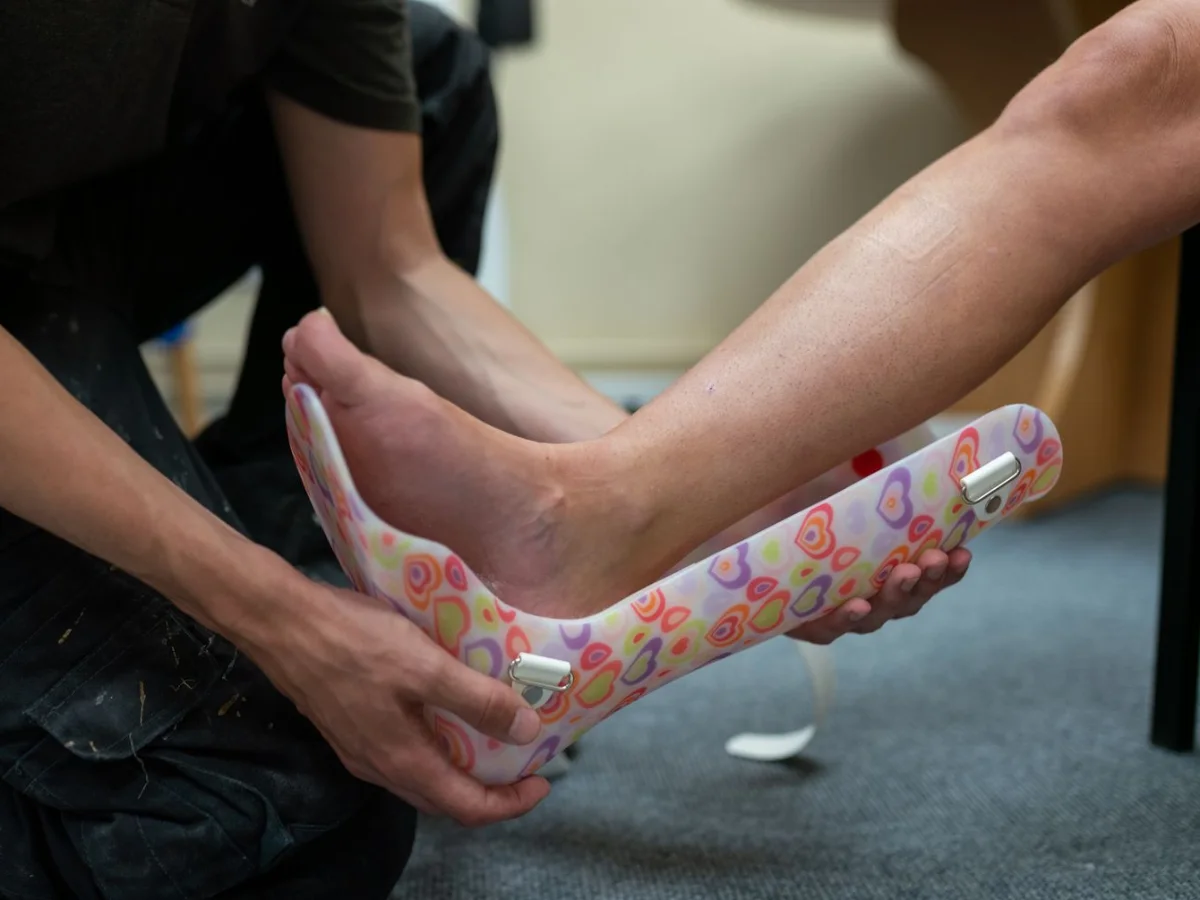
It holds the foot up once foot drop starts, helps control the heel, and works best while the foot can still be held flat. A 2024 review of 15 small studies found positive but not statistically significant effects on walking, and stressed individual fitting. Choosing and fitting a brace.
For a flexible foot, surgeons release the tight plantar fascia, move tendons (for example the peroneus longus onto the peroneus brevis, or the tibialis posterior to the top of the foot to help lift it) and reset bones (osteotomies) in the first metatarsal and the heel. Fusing joints (arthrodesis) is generally kept for rigid feet or advanced arthritis.
The evidence for surgery is limited. A 2020 consensus statement from 13 foot and ankle surgeons and a neurologist rates its own evidence as expert opinion (level V), and a 2026 review found most studies small and retrospective. In the longest, 41 feet followed for about 26 years, the arch correction generally held, but most people had some return of the inward heel tilt; 8 feet needed more surgery and 11 developed moderate to severe arthritis. The consensus advises seeing a foot and ankle surgeon early, and reviews favor surgery before the foot stiffens.
Protecting numb feet. Check your feet and the skin under any brace every day, and wear shoes and socks, even indoors. The two-minute daily foot check.
Living with CMT
- Exercise, planned and moderate. Low-impact activity such as cycling or swimming, plus a strength program planned with a physical therapist; the NHS warns that overexertion can worsen symptoms. A 2023 review of six trials found moderate-quality evidence only in children, where strengthening the muscles that lift the foot slowed their weakening over two years. Balance and strength exercises.
- Walking aids and weight. A cane, a walker or walking poles can help, and a healthy weight makes walking easier.
- Hands. An occupational therapist can suggest thumb splints and aids such as clothing with clasps instead of buttons.
- Pain and fatigue. Acetaminophen or anti-inflammatories may ease muscle and joint pain, and gabapentin or tricyclic antidepressants nerve pain; each has side effects. Mention fatigue too. Treating nerve pain.
Medicines to be careful with. The chemotherapy drug vincristine is the best documented: its US label says people with the demyelinating form of CMT should not be given it, and it can cause severe, sometimes permanent worsening. The CMT Association’s list, revised in 2023 after a systematic review, names only vincristine and paclitaxel, another cancer drug. The review found no convincing evidence of a special risk from other nerve-toxic drugs, and said people with CMT should get effective treatment, with close monitoring of their nerves. Tell every prescriber you have CMT, and mention a family history before chemotherapy: vincristine has unmasked CMT in someone with no symptoms. Don’t stop a prescribed medicine on your own. Nerve damage from chemotherapy.
Research: what is being tested
As of September 2026, no medicine is approved to slow or stop any form of CMT. Trials include:
- Gene silencing for CMT1A. In September 2025, Novartis began a placebo-controlled phase 1 safety trial in Canada of EDK060, an RNA-based drug developed to lower PMP22.
- Gene therapy for CMT4J, an ultra-rare recessive form. The FDA cleared a phase 1/2 trial of ELP-02, which delivers a working copy of the FIG4 gene, in December 2024, with treatment planned to start in 2026.
- Govorestat for CMT-SORD, in which sorbitol builds up. It lowered sorbitol in a phase 2/3 trial reported in 2025, but the main walking test did not beat placebo. In April 2026 its new owner, Cycle Pharmaceuticals, stopped all studies of the drug while it works out with the FDA what more data are needed.
Ask your neurologist, or search ClinicalTrials.gov, for studies that fit your type.
Outlook
Severity varies widely, even within a family, and CMT that starts in early childhood can be more severe. Some forms bring hearing loss, a curved spine or hip problems, and a few affect breathing or swallowing.
When to get help urgently
- Call 911 for sudden numbness or weakness in the face, an arm or a leg, especially on one side of the body, sudden trouble speaking, or sudden loss of balance. These can be signs of a stroke. CMT itself progresses slowly.
- Go to an emergency department, or call 911, for weakness that spreads over hours or days, often after tingling in the feet, or for any new trouble breathing or swallowing. These can be signs of Guillain-Barré syndrome, which needs hospital care.
- Be seen the same day or the next for a warm, red, swollen foot without an injury, which in a numb foot can be Charcot foot or an infection; keep weight off it until then. The same goes for a blister, cut or callus that turns red, warm, swollen or painful, comes with a fever, or hasn’t started to heal within a few days.
- Call your doctor within days about a foot drop on one side that comes on over days or weeks, which may mean pressure on a nerve at the knee, or right away if it follows an injury, an operation or a cast. Get emergency care if it comes on suddenly or with back pain, numbness around the groin, or bladder or bowel trouble, or if the leg is very painful, swollen or tight. Call promptly, too, if weakness is worsening over weeks rather than years.
- During chemotherapy, report new or worsening numbness or weakness to your cancer team promptly.
Common questions
What are the first signs of Charcot-Marie-Tooth disease?
Usually changes in the feet and ankles: high arches, curled toes, clumsiness, trouble running, frequent ankle sprains and tripping. Foot drop, thin calves and numb feet often follow. Symptoms usually begin between childhood and early adulthood. High arches with inward-tilting heels on both feet, especially with a family history, deserve a check for CMT.
What does CMT do to your feet?
Weak muscles at the front and outer side of the shin lose out to stronger ones, so the arch rises, the heel tilts inward and the toes claw. This cavovarus foot brings ankle sprains, calluses and fifth metatarsal fractures, and the same weakness causes foot drop. Stretching, supportive shoes, orthoses, braces and sometimes surgery help.
Is Charcot-Marie-Tooth disease hereditary?
Yes. The most common types are dominant, so each child of an affected parent has a 50 percent chance of inheriting it. X-linked and recessive types follow other patterns. About 10 percent of cases start with a new genetic change, so there may be no family history.
What is the life expectancy with CMT?
Usually normal. MedlinePlus Genetics and the NHS both say most people with CMT have a normal life expectancy, and the NHS says losing the ability to walk completely is unusual. Severity varies widely, even within a family. A few forms can weaken breathing, so new trouble breathing needs urgent care.
Is there a cure for Charcot-Marie-Tooth disease?
Not yet. As of September 2026, no medicine is approved to slow or stop any form of CMT, though gene silencing, gene therapy and drug trials are under way. Care means physical therapy, stretching, supportive shoes, orthoses and braces, foot surgery when needed, pain treatment, and making sure every doctor knows you have CMT, because the chemotherapy drug vincristine can badly worsen it.
Related reading
Foot drop: finding the level · Foot drop braces · Types of neuropathy · Nerve conduction study and EMG · Foot drop exercises · Chemotherapy-induced neuropathy
Sources and further reading: NINDS, Charcot-Marie-Tooth disease, 2026, and NINDS, peripheral neuropathy, 2026. MedlinePlus Genetics, Charcot-Marie-Tooth disease, 2026, and hereditary neuropathy with liability to pressure palsies, 2016. Bird TD, Charcot-Marie-Tooth hereditary neuropathy overview, GeneReviews, 2025. Nagappa M, Sharma S, Taly AB, Charcot-Marie-Tooth disease, StatPearls, 2024. Burns J, Timmerman V, Laurá M et al., Charcot–Marie–Tooth disease and related neuropathies, Nature Reviews Disease Primers, 2026. Ma M et al., A meta-analysis on the prevalence of Charcot–Marie–Tooth disease and related inherited peripheral neuropathies, Journal of Neurology, 2023. Mayo Clinic, Charcot-Marie-Tooth disease: symptoms and causes and diagnosis and treatment, 2025. NHS, Charcot-Marie-Tooth disease and treatment, 2022. Charcot–Marie–Tooth Association, What is CMT?, What are the symptoms of CMT? (leaflet posted 2019), Why CMT symptoms vary and Neurotoxic medications, list revised 2023. Record CJ et al., Whole genome sequencing increases the diagnostic rate in Charcot-Marie-Tooth disease, Brain, 2024. On the foot: Waldman LE, Michalski MP, Giaconi JC, Pfeffer GB, Learch TJ, Charcot-Marie-Tooth disease of the foot and ankle: imaging features and pathophysiology, RadioGraphics, 2023. Moon SJ, Min YK, Pfeffer GB et al., Charcot–Marie–Tooth cavovarus foot: current concepts and emerging strategies for deformity correction, Journal of Clinical Medicine, 2026, which also summarizes Ward CM et al., Journal of Bone and Joint Surgery, 2008. Pfeffer GB et al., A consensus statement on the surgical treatment of Charcot-Marie-Tooth disease, Foot & Ankle International, 2020, and the CMT Association’s summary. Laurá M et al., Prevalence and orthopedic management of foot and ankle deformities in Charcot-Marie-Tooth disease, Muscle & Nerve, 2018. Nagai MK et al., Prevalence of Charcot-Marie-Tooth disease in patients who have bilateral cavovarus feet, Journal of Pediatric Orthopaedics, 2006. Burns J, Landorf KB, Ryan MM, Crosbie J, Ouvrier RA, Interventions for the prevention and treatment of pes cavus, Cochrane review, 2007, searches updated to 2010. Kim A, Frecklington M, Philps A, Stewart S, The effect of ankle-foot orthoses on gait characteristics in people with Charcot-Marie-Tooth disease: a systematic review and meta-analysis, Journal of Foot and Ankle Research, 2024. On exercise: Burns J et al., Safety and efficacy of progressive resistance exercise for Charcot-Marie-Tooth disease in children, Lancet Child & Adolescent Health, 2017. Conde RM et al., Effectiveness of exercise therapy for individuals diagnosed with Charcot–Marie–Tooth disease: a systematic review of randomized clinical trials, Journal of the Peripheral Nervous System, 2023. On medicines: Cavaletti G, Forsey K, Alberti P, Toxic medications in Charcot–Marie–Tooth patients: a systematic review, Journal of the Peripheral Nervous System, 2023. Vincristine sulfate injection prescribing information (Hospira), DailyMed, 2025. Jariwal R et al., Unmasking a case of asymptomatic Charcot-Marie-Tooth disease (CMT1A) with vincristine, Journal of Investigative Medicine High Impact Case Reports, 2018. On research: Park J-M, Update on Charcot-Marie-Tooth disease: evolving genetic classification, trial readiness, and emerging therapies, Annals of Clinical Neurophysiology, 2026. Peripheral Nerve Society, Spotlight on CMT, vol. 16, 2026. Novartis, A first-in-human study of EDK060 in adults with CMT1A (NCT07140614), started 2025, and CMT Research Foundation, Novartis CMT1A research, 2026. Elpida Therapeutics, FDA clearance of the IND application for ELP-02, 2024, and CMT Research Foundation, Gene therapy, 2026. CMT Research Foundation, Applied Therapeutics presents findings from phase 2/3 clinical trial of govorestat in CMT-SORD, 2025, and Applied Therapeutics, Update following meeting with FDA, 2025, and Charcot–Marie–Tooth Association, Cycle Pharmaceuticals stops clinical studies of govorestat, 2026. On Charcot foot: Dardari D, An overview of Charcot’s neuroarthropathy, Journal of Clinical & Translational Endocrinology, 2020. Singh D, Gray J, Laura M, Reilly MM, Charcot neuroarthropathy in patients with Charcot Marie Tooth disease, Foot and Ankle Surgery, 2021. Collins AC, Bergman R, Charcot neuropathic osteoarthropathy, StatPearls, 2026. Warning signs: CDC, stroke signs and symptoms; AAOS OrthoInfo, cauda equina syndrome; AAOS OrthoInfo, compartment syndrome; NINDS, Guillain-Barré syndrome; NIDDK, diabetes and foot problems.
This page is general education and is not a diagnosis, a treatment plan, or a substitute for care from your own clinician. Clinical review by Dr. Biernacki is pending; the review date will be shown here once complete.
For our Michigan neighbors
High arches, weak ankles
and a family history?
A foot and ankle examination can tell a flexible high arch from a rigid one and match orthoses, bracing or surgery to your stage. Dr. Biernacki’s Michigan practice can start there.
Everywhere else, take this page to your own clinician.

Dr. Tom Biernacki, DPM, FACFAS is a double board-certified foot and ankle surgeon (ABFAS and ABPM) and a Fellow of the American College of Foot & Ankle Surgeons. He is the founder of Balance Foot & Ankle in Howell and Bloomfield Township, Michigan, where peripheral neuropathy, diabetic foot risk and loss of protective sensation are part of his weekly clinic. His patient education videos have drawn more than 950,000 subscribers on YouTube. Managing Neuropathy is written by its editorial team under his direction, to put the explanation he gives in the exam room in front of the people who cannot get to one — including when a product is worth buying and when it is not.