Diagnosis
Axonal neuropathy: what it means, causes and treatment
Axonal neuropathy means the nerve fibers themselves, the long, wire-like axons that carry nerve signals, are damaged or lost, rather than the insulation around them. Most polyneuropathies are mainly axonal, and most begin in the feet and progress over months or years. Diabetes is the most common cause, and in roughly a quarter of people no cause is found.
Written by the Managing Neuropathy editorial team under the direction of Dr. Tom Biernacki, DPM, FACFAS · Clinical review pending · Last updated 11 October 2026
The short answer. “Axonal” on a nerve test report means the nerve signals were smaller than normal but traveled at close to normal speed: fewer nerve fibers are working, rather than their insulating coating (myelin) being damaged, which slows signals instead. Most axonal neuropathy is “length-dependent”: it starts in the toes of both feet and creeps slowly upward, and “sensorimotor” means both the feeling and the muscle-control nerves are involved. Diabetes is the most common cause. Blood tests for glucose, vitamin B12 and an abnormal blood protein are the most likely to point to a cause, and treatment is aimed at the cause, the nerve pain, and protecting the feet and balance. Axons regrow slowly, so nerve recovery takes months, and when no cause is found the neuropathy usually progresses slowly and rarely becomes severely disabling.
What “axonal” means
Each nerve is a bundle of many nerve fibers. The core of each fiber is the axon, the long branch of a nerve cell that carries its messages. Many axons are wrapped in myelin, an insulating coating that lets signals travel quickly. A neuropathy can damage either part. In axonal neuropathy the axons themselves degenerate or are lost; in demyelinating neuropathy the myelin coating is damaged.
Most polyneuropathies are mainly axonal. Most are also “length-dependent”: the nerve endings farthest from the brain, in the feet, are affected first or worst. That is why axonal neuropathy usually starts in the toes. How the different types of neuropathy are named.
Reading your nerve test report
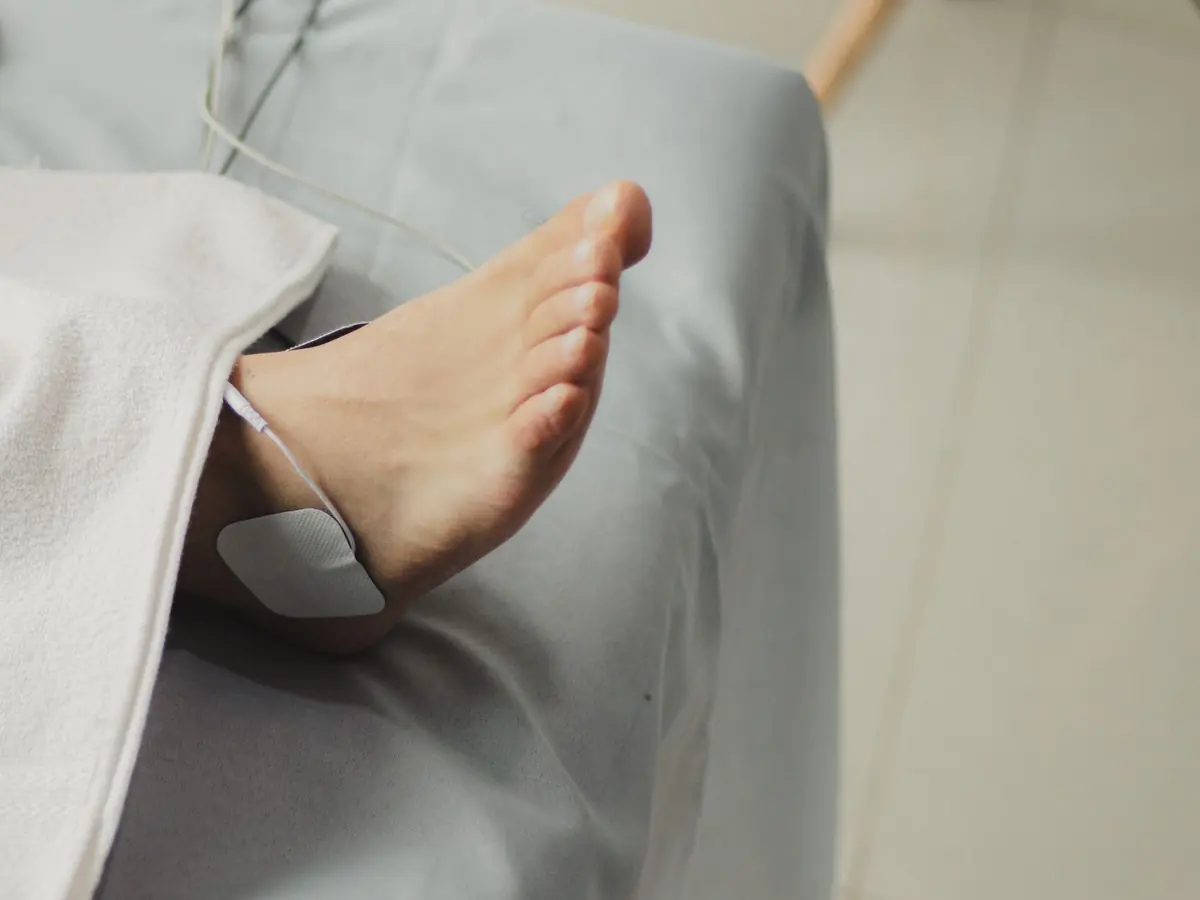
A nerve conduction study sends small electrical pulses along nerves in the legs and arms and measures how strong each response is (its amplitude) and how fast it travels (its conduction velocity and latency). The amplitude gives a clue to how many working axons are left. A smaller signal at a near-normal speed points to axon damage; much slower speeds, delayed latencies or a block along the nerve point to myelin damage. What the test is like, and how to prepare.
| Words on the report | What they mean |
|---|---|
| Axonal | Smaller-than-normal responses at near-normal speed: fewer working nerve fibers. |
| Demyelinating | Slowed speeds, delayed latencies or conduction block: damaged insulation. |
| Mixed axonal and demyelinating | Features of both patterns. Ask the doctor who did the test which one is the main problem. |
| Length-dependent | The longest nerves, to the feet, are most affected, so symptoms start in the toes. |
| Sensorimotor | Both the feeling (sensory) and the muscle-control (motor) nerves are involved. “Sensory” alone means feeling nerves only. |
| Polyneuropathy | Many nerves are affected, usually evenly on both sides. |
| Fibrillations or positive sharp waves (EMG) | Some muscle fibers have lost their nerve supply. |
| Large motor units, or reinnervation (EMG) | Surviving nerve fibers have branched out to take over muscle fibers that lost their own, which takes time to happen. |
A normal nerve conduction study doesn’t rule out neuropathy, because it tests only the large nerve fibers. Damage to the small fibers that carry pain and temperature needs other tests, such as a skin biopsy. More on small fiber neuropathy.
Symptoms
Length-dependent axonal neuropathy usually starts in the toes and feet on both sides and spreads slowly upward, in a “stocking” pattern. The hands usually become involved later, after the legs.
- Numbness, tingling, burning or pain in the toes and feet. Symptoms are often worse at night.
- Poor balance, especially in the dark, with the eyes closed or on uneven ground, because the feet no longer report their position well. Polyneuropathy is linked with walking problems and a higher risk of falls.
- Weakness of the toes and ankles in later stages, with shrinking muscles. Some people develop a foot drop. Cramps can also occur, and a doctor may find weak or absent ankle reflexes.
- Injuries you don’t feel, such as blisters and sores on numb feet, which can become infected.
Numbness in the feet, by pattern and cause.
What causes it
Diabetes is the leading cause of peripheral neuropathy in the US, and neuropathy affects 25 to 50 percent of people with diabetes. More on diabetic neuropathy. Other recognized causes of this both-sides pattern include:
- Alcohol. Alcohol-related neuropathy.
- Vitamin problems: low vitamin B12, too much vitamin B6, and sometimes low levels of other nutrients, such as thiamine, folate, copper or vitamin E.
- Chemotherapy and some other medicines. Chemotherapy-induced neuropathy.
- Kidney disease and thyroid disease.
- Infections, such as HIV, hepatitis C and Lyme disease.
- An abnormal protein in the blood, called a monoclonal gammopathy (such as MGUS), which can be linked with neuropathy.
- Inherited neuropathy. Charcot-Marie-Tooth disease type 2 is the axonal form; type 1 is demyelinating. More on Charcot-Marie-Tooth disease.
- Critical illness. A severe illness treated in intensive care, especially with sepsis or organ failure, can damage nerves and muscles.
- Toxins, such as heavy metals and some industrial chemicals.
If routine blood sugar tests are normal, doctors may consider a glucose tolerance test to look for prediabetes, especially when the neuropathy is painful.
When no cause is found
In roughly a quarter of people, and more often in older adults, no cause is found even after a full work-up. When the nerve test shows axonal damage, this is called chronic idiopathic axonal polyneuropathy, or CIAP. It usually begins in a person’s 50s or later and creeps slowly over years, with numbness and sometimes weakness in the feet and lower legs, and sometimes the hands.
The outlook is usually reassuring. In a Dutch study that followed 75 people with CIAP for five years, the neuropathy progressed slowly, any handicap was not severe, and a definite cause turned up in only four of them. It can still lower quality of life, for example through pain, numbness and unsteadiness, which is why the treatment below matters.
Tests to find the cause
According to American Academy of Neurology guidance, first published in 2009 and since reaffirmed, the blood tests most likely to find a cause are blood glucose, vitamin B12 with methylmalonic acid, and serum protein immunofixation electrophoresis, which looks for an abnormal protein. Family-medicine guidance adds a blood count, a metabolic panel and a thyroid test (TSH).
Nerve conduction studies and EMG matter most when symptoms came on suddenly, affect one side, are mainly weakness or are worsening quickly, or when the first tests are normal and symptoms persist. Genetic testing may be considered when no cause is found and the neuropathy looks inherited; whether the nerve test is axonal or demyelinating helps decide which genes to test.
Once a thorough work-up has found nothing, repeating the same blood tests routinely adds little. New tests make sense if something changes.
Treatment
Treatment has three parts: the cause, the symptoms, and protecting the feet and balance.
- Treat the cause where there is one. In type 1 diabetes, tighter blood sugar control clearly helps prevent neuropathy; in type 2 the benefit is smaller and less certain. In both types, very tight control raises the risk of severe low blood sugar, so targets are set with your diabetes team. Stopping alcohol helps prevent further damage, though alcohol-related nerve damage is usually permanent. If you drink heavily, get medical help before you stop, because stopping suddenly can be dangerous. Low B12 is replaced, thyroid disease is treated, and a medicine that may be responsible is changed only with the prescriber.
- Nerve pain. The UK’s NICE recommends starting with one of amitriptyline, duloxetine, gabapentin or pregabalin, and switching to another if the first doesn’t help or isn’t tolerated. For painful diabetic neuropathy, the American Academy of Neurology also lists sodium-channel blockers, says the goal is to reduce pain, not necessarily to stop it completely, and advises against opioids. The best choice depends on side effects, your other health conditions and medicines, and cost. Neuropathy medicines compared.
- Foot protection. Check numb feet every day for blisters, cuts and calluses, and wear well-fitting, protective shoes. How to do a daily foot check.
- Balance and strength. Physical therapy with gait and balance training can improve balance and confidence, and strength exercises may help weak muscles. The evidence that it prevents falls is limited. Exercises for neuropathy.
- Foot drop. A lightweight ankle-foot brace (AFO) holds the front of the foot up while walking. Choosing a foot drop brace.
For chronic idiopathic axonal polyneuropathy, no drug has been proven to slow or reverse the neuropathy itself, so treatment targets pain, balance and the feet.
Recovery and outlook
How well you do depends on the cause and on how long the nerves have been damaged. When the cause is corrected early, some neuropathies improve as the nerves recover and regrow. Often, though, the realistic goal is to stop the neuropathy getting worse and to manage its symptoms. Can neuropathy be reversed?
Axons regrow slowly. After a nerve injury, specialists quote a rate of about 1 millimeter a day, roughly an inch a month, in good conditions, and the nerve fibers to the toes are the longest in the body. Myelin repairs faster than axons regrow: in Guillain-Barré syndrome, for example, myelin damage usually improves within weeks, while axon damage can take many months, up to about three years, and often recovers incompletely.
Axonal vs demyelinating neuropathy
| Axonal | Demyelinating | |
|---|---|---|
| What is damaged | The axon, the nerve fiber itself | The myelin insulation around it |
| Nerve conduction study | Smaller responses, speed near normal | Slowed speed, delayed latencies, conduction block |
| Typical causes | Diabetes, alcohol, low B12, chemotherapy, CMT type 2, or no cause found | The most common type of Guillain-Barré syndrome, CIDP, anti-MAG neuropathy, CMT type 1 |
| Main treatment | Treat the cause, plus pain relief and foot and balance care | Guillain-Barré syndrome: IVIG or plasma exchange (steroids do not help). CIDP: IVIG, steroids or plasma exchange. Anti-MAG neuropathy responds less well to these. CMT has no cure, but physical therapy and braces help. |
| Recovery | Slow and often incomplete | Can be quicker once treated, because myelin repairs faster |
The two can overlap. Some reports describe a mixed pattern, and Guillain-Barré syndrome has axonal forms, called AMAN and AMSAN, as well as the more common demyelinating one.
When to get help urgently
- Go to an emergency department for weakness or tingling that is spreading over hours or days, and call 911 if you also have trouble breathing or swallowing. These can be signs of Guillain-Barré syndrome.
- Call 911 for sudden numbness or weakness of the face, arm or leg, especially on one side, or sudden trouble speaking, seeing or walking. These can be signs of a stroke.
- Get seen promptly if symptoms came on suddenly or are getting worse quickly, affect one side or separate patches rather than both feet evenly, are mainly weakness without numbness, or started in the hands. These patterns need a neurologist’s assessment. When separate nerves are damaged in patches.
- See a clinician the same day for a wound on a numb foot, or for redness, swelling or warmth in one.
Common questions
Is axonal neuropathy serious?
It depends on the cause. Most chronic axonal neuropathy progresses slowly, over months or years, and when no cause is found it rarely becomes severely disabling, though it can lower quality of life. The main day-to-day risks are falls and foot injuries you don’t feel. Weakness or tingling that spreads over hours or days is different and needs emergency care.
Can axonal neuropathy be reversed?
Sometimes, at least partly, when the cause is found and corrected early: low vitamin B12, too much vitamin B6, or a medicine, for example. Axons regrow slowly, so improvement takes months. Alcohol-related nerve damage is usually permanent, and for many people the goal is to stop the neuropathy getting worse.
What does “length-dependent axonal sensorimotor polyneuropathy” mean?
In plain words: many nerves are affected (polyneuropathy), mostly the longest ones, to the feet (length-dependent); the nerve fibers themselves are damaged rather than their insulation (axonal); and both the feeling and the muscle-control nerves are involved (sensorimotor). It is the typical pattern of the most common neuropathies, including diabetic neuropathy.
Is axonal neuropathy worse than demyelinating neuropathy?
Not simply. Axon damage recovers more slowly and less completely than myelin damage, but the most common axonal neuropathies progress slowly. Some demyelinating neuropathies can cause serious weakness, Guillain-Barré syndrome within days and CIDP over two months or more, though both often respond to immune treatment. The cause matters more than the label.
What is the most common cause of axonal neuropathy?
Diabetes. Other causes include alcohol, low vitamin B12, chemotherapy and other medicines, kidney and thyroid disease, and inherited neuropathy. In roughly a quarter of people no cause is found, and that becomes more common with age.
Related reading
Nerve conduction study and EMG · Types of neuropathy · Diabetic neuropathy · Vitamin B12 neuropathy · Small fiber neuropathy · Can neuropathy be reversed? · Neuropathic pain
Sources and further reading: NINDS, Peripheral neuropathy, Guillain-Barré syndrome and Charcot-Marie-Tooth disease. MedlinePlus, Nerve conduction velocity, Peripheral neuropathy, Alcoholic neuropathy and Alcohol withdrawal. Castelli G et al., Peripheral neuropathy: evaluation and differential diagnosis, American Family Physician, 2020. England JD et al., Evaluation of distal symmetric polyneuropathy: the role of laboratory and genetic testing (AAN, AANEM and AAPM&R practice parameter, 2009, reaffirmed). American Academy of Neurology, Oral and topical treatment of painful diabetic polyneuropathy, 2022. NICE, Neuropathic pain in adults: pharmacological management in non-specialist settings (CG173), 2013, updated 2020. Ginsberg MR et al., Using and interpreting electrodiagnostic tests, Cleveland Clinic Journal of Medicine, 2020. Foundation for Peripheral Neuropathy, Electrodiagnostic testing and Anti-MAG. Hanewinckel R et al., The epidemiology and risk factors of chronic polyneuropathy, European Journal of Epidemiology, 2016. Warendorf J et al., Drug therapy for chronic idiopathic axonal polyneuropathy, Cochrane, 2017. Notermans NC et al., Chronic idiopathic axonal polyneuropathy: a five year follow up, Journal of Neurology, Neurosurgery and Psychiatry, 1994. Samuelsson K, Press R, Microangiopathy—a potential contributing factor to idiopathic polyneuropathy: a mini review, Frontiers in Neurology, 2018. Callaghan BC et al., Enhanced glucose control for preventing and treating diabetic neuropathy, Cochrane. Merck Manual Professional, Polyneuropathy. Charcot-Marie-Tooth Association, CMT types. Nerve regrowth: American Society for Surgery of the Hand, Nerve injury; Inflammatory Neuropathies UK, Guillain-Barré syndrome. Foot care and braces: NIDDK, peripheral neuropathy; NINDS, foot drop. Stroke warning signs: CDC, stroke signs and symptoms.
This page is general education and is not a diagnosis, a treatment plan, or a substitute for care from your own clinician. Clinical review by Dr. Biernacki is pending; the review date will be shown here once complete.
For our Michigan neighbors
Numb or burning feet,
and a nerve test report?
Axonal neuropathy is usually diagnosed and followed by a neurologist or your primary care clinician. Numb feet also deserve a foot examination, protective footwear and help with balance, and Dr. Biernacki’s Michigan practice can help with that part.
Everywhere else, take this page to your own clinician.

Dr. Tom Biernacki, DPM, FACFAS is a double board-certified foot and ankle surgeon (ABFAS and ABPM) and a Fellow of the American College of Foot & Ankle Surgeons. He is the founder of Balance Foot & Ankle in Howell and Bloomfield Township, Michigan, where peripheral neuropathy, diabetic foot risk and loss of protective sensation are part of his weekly clinic. His patient education videos have drawn more than 950,000 subscribers on YouTube. Managing Neuropathy is written by its editorial team under his direction, to put the explanation he gives in the exam room in front of the people who cannot get to one — including when a product is worth buying and when it is not.