Diagnosis
The Romberg test: how it’s done and what a positive result means
The Romberg test asks one question: can you stay upright with your feet together once your eyes are closed? A little sway is normal. Staying steady with your eyes open but losing your balance as soon as they close is a positive Romberg sign, and in a foot and nerve clinic the usual reason is that the feet have stopped reporting where they are.
Written by the Managing Neuropathy editorial team under the direction of Dr. Tom Biernacki, DPM, FACFAS · Clinical review pending · Last updated 14 November 2026
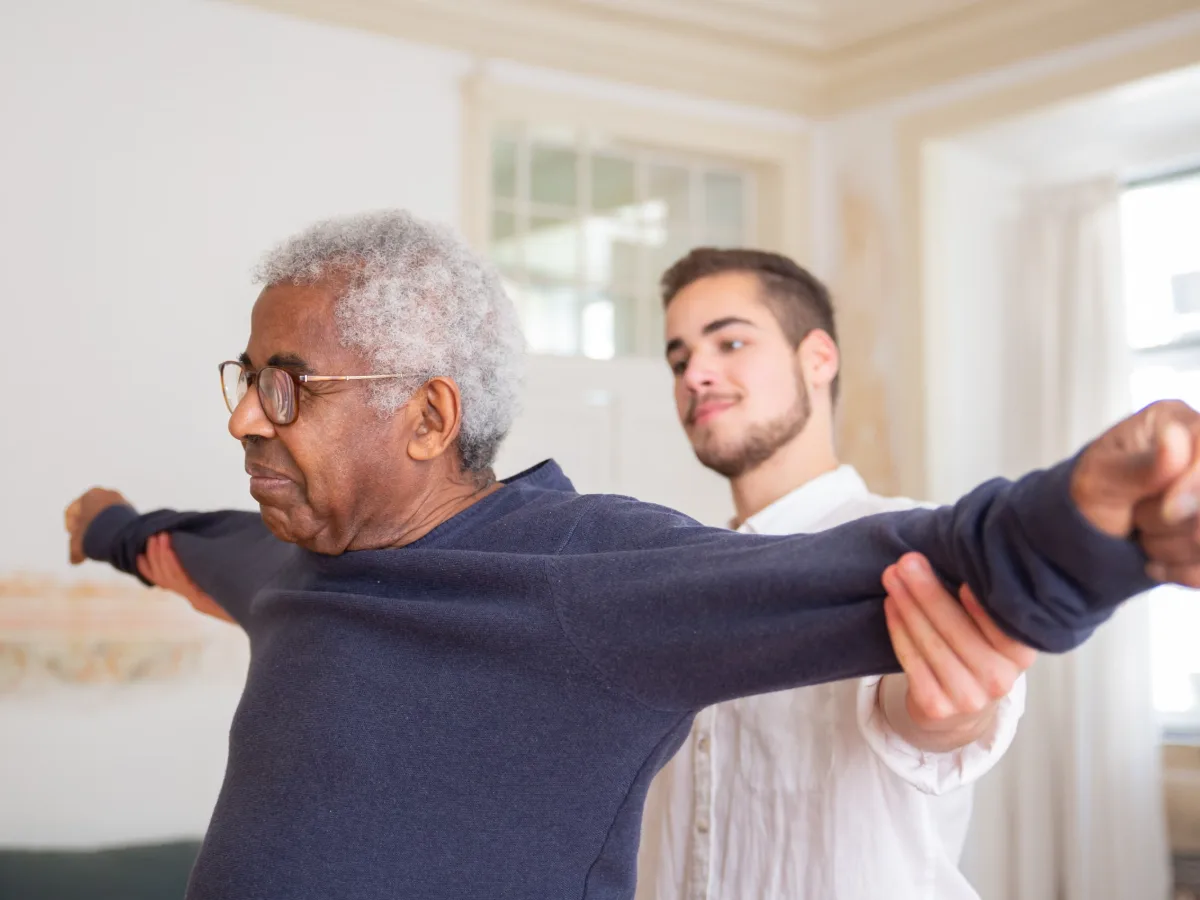
The short answer. You stand with your feet together and your arms by your sides or crossed, first with your eyes open for about 30 seconds, then with your eyes closed for 30 seconds to a minute, with someone close enough to catch you. If you are steady with your eyes open but have to step, stagger or be caught once they close, the test is positive. That points to lost position sense from the feet and legs, from a large-fiber neuropathy, low vitamin B12 or a problem in the back of the spinal cord, or less often to an inner ear problem. If you can’t stand steadily even with your eyes open, the test isn’t positive in the Romberg sense: the cause is more likely in the cerebellum, the muscles or elsewhere, and needs a broader exam. A positive result is a clue, not a diagnosis. In someone with numb feet, we treat it first as a fall warning.
Why closing your eyes matters
Standing still looks effortless, but your brain is blending three streams of information to do it: what your eyes see, what your inner ears sense about the position and movement of your head, and position sense, the constant report from the soles, ankles and joints about where your body is. Position sense travels in the largest, fastest sensory nerve fibers and then up the back of the spinal cord, in the dorsal columns.
Lose one stream and the other two usually cover for it. That is the idea behind the test. With the feet together, the base you stand on is narrow. Closing your eyes takes vision away. If position sense from the feet is also missing, the inner ear is left to do the job alone, and it can’t: the body starts to sway, then tips. Someone whose eyes are quietly doing the work can look completely normal in the exam room until they close them.
The same thing happens at home. The patients who tell us they walk fine in daylight but stagger to the bathroom at night, lose their balance in the shower when they close their eyes to rinse their hair, or wobble on grass and gravel are describing a positive Romberg, often long before anyone has tested for one.
How the Romberg test is done
- Shoes off, on a firm, flat floor, with the area around you cleared and the examiner standing close beside or behind you.
- Feet together, heels and big toes touching, with your arms by your sides or crossed over your chest.
- Eyes open for about 30 seconds while the examiner watches how much you sway.
- Eyes closed for 30 seconds to a minute. The examiner looks for a clear change: sway that keeps growing, a step to catch yourself, or a fall.
The examiner doesn’t hold you during the test but stays close enough to catch you. Nothing is measured with an instrument; the result is what the examiner sees.
Reading the result
| What happens | What it is called | What it usually points to |
|---|---|---|
| Steady with the eyes open and closed, with a little sway either way | Negative (normal) | Position sense and the inner ear are doing their jobs. It doesn’t rule out neuropathy: small fiber neuropathy and early neuropathy usually leave balance normal. |
| Steady with the eyes open; sways hard, steps or falls once the eyes close | Positive Romberg sign | Lost position sense, from a large-fiber neuropathy, low vitamin B12 or a problem in the back of the spinal cord; less often, lost inner ear function |
| Unsteady, swaying or needing support even with the eyes open | Not a Romberg sign; the test can’t be read | A problem in the cerebellum (the brain’s coordination center), weak legs, Parkinson’s disease, dizziness or very severe sensory loss; needs a fuller exam |
The last row is the distinction most often missed. The Romberg test is commonly mistaken for a test of the cerebellum, but people with cerebellar problems tend to be unsteady with their eyes open too, so closing them changes less. The test is built to catch the person who is steady only while they can see.
It is also a blunt instrument. When researchers measured sway on a force plate in people with pure sensory neuropathy, sway roughly doubled with the eyes closed, but the patients also swayed more than healthy people with their eyes open, which shrinks the contrast the bedside test depends on, and the test separated patients from healthy people only modestly. That is why we read a Romberg result alongside the rest of the exam, never on its own.
What causes a positive Romberg
The nerves: large-fiber neuropathy
This is the cause we see most. When the large sensory fibers of the feet and legs are damaged, position sense and vibration sense fade together, usually with numbness that began in the toes. Causes include advanced diabetic neuropathy, chemotherapy (especially the platinum drugs), alcohol, inherited neuropathies such as Charcot–Marie–Tooth disease, and immune neuropathies such as CIDP. Large fiber neuropathy.
A smaller group damages the sensory nerve cells themselves, which sit in small clusters beside the spine. These sensory neuronopathies, seen with Sjögren’s syndrome, some cancers, platinum chemotherapy and very high doses of vitamin B6, can produce some of the most striking positive Romberg results, sometimes affecting the hands or face early rather than starting in the toes. Vitamin B6 toxicity.
The spinal cord: the dorsal columns
Position sense from the legs travels up the back of the spinal cord, so damage there gives the same result. Vitamin B12 deficiency is the classic cause, damaging the nerves and the cord together (subacute combined degeneration). Low B12 can follow years of metformin or acid-reducing medicines, a vegan diet without supplements, weight-loss or other stomach surgery, or pernicious anemia, and recreational nitrous oxide (“whippets”) can bring it on quickly by inactivating B12. Copper deficiency, often after stomach surgery, including weight-loss surgery, or from too much zinc, produces an almost identical picture. A narrowed spinal canal in the neck pressing on the cord, multiple sclerosis and, rarely now, late syphilis, the disease Romberg himself was describing, can do the same. Vitamin B12 and neuropathy.
The inner ear
When both inner ears have lost function, the eyes and feet carry the load, and closing the eyes can bring on the same sway and fall. In one large series of people with loss in both inner ears, the most common identifiable cause was a group of antibiotics (the aminoglycosides, such as gentamicin), followed by Ménière’s disease. These patients often have other clues: the world seems to bounce when they walk, or they have had attacks of vertigo or hearing changes. Standing with the eyes closed on a foam cushion leans harder on the inner ear, which is why balance clinics often add that version.
Balance problems that aren’t a Romberg sign
Problems with the cerebellum, from alcohol, a stroke or an inherited ataxia, Parkinson’s disease, weak legs, a drop in blood pressure on standing and medicines that cause drowsiness or dizziness all affect balance, usually with the eyes open as well. They matter just as much for falls, and a full balance exam looks for all of them.
The versions you may come across
- The sharpened (tandem) Romberg: heel to toe, as on a tightrope, with the eyes closed. It is harder and more sensitive, and is used in diving medicine to check divers after decompression illness. The ability to hold it with the eyes closed declines with age even in healthy adults, so the result is read against age norms.
- Romberg on foam: standing on a foam pad with the eyes closed, which tests the inner ear more than the feet.
- The single-leg stance: standing on one leg with the eyes open. In a University of Michigan study of older adults with neuropathy, those who had fallen in the past year could hold it for about 3 seconds on average, against about 9 seconds for those who hadn’t.
- The CDC 4-Stage Balance Test: four positions, each held for 10 seconds with the eyes open: feet side by side, the instep of one foot touching the big toe of the other, heel to toe, and one leg. An older adult who can’t hold the heel-to-toe stand for 10 seconds is at increased risk of falling.
- The modified Romberg used by some police officers: feet together, head tilted back and eyes closed while estimating when 30 seconds have passed. It isn’t one of the standardized field sobriety tests approved by the National Highway Traffic Safety Administration.
Checking your balance at home: never alone
Our view: if you want to check your balance at home, use the CDC’s 4-Stage Balance Test rather than the eyes-closed Romberg, and don’t do either alone. A positive Romberg means losing your balance, by definition.
- Stand in the corner of a room or with a sturdy counter in front of you, and have another adult right beside you, ready to hold you.
- Keep your eyes open, and move to the next position only if you held the last one for 10 seconds without moving your feet.
- Don’t test at all if you have fallen recently, feel dizzy or can’t stand without holding on. Tell your clinician instead.
- If you can’t hold the heel-to-toe stand for 10 seconds, or you sway sharply when you close your eyes with your feet together and someone beside you, book a balance assessment.
A positive Romberg with numb feet is a fall warning
The link between neuropathy and falls is not subtle. In the University of Michigan study, 55% of older adults with neuropathy confirmed by nerve testing had fallen in the previous year, against 10% of matched adults with normal nerves, and no other risk factor explained the difference. In a small study of younger adults with long-standing type 1 diabetes, those with neuropathy had about 15 times the odds of reporting an injury while walking. And in a large U.S. study of adults in their late seventies, neuropathy found with a simple monofilament test raised the risk of a fall or fracture by about half.
So when the Romberg is positive and the feet are numb, we don’t stop at naming the cause. We look at the shoes, the home, the medicines and the eyes, because vision is now doing a job the feet used to share.
If your Romberg is positive: what comes next
- The rest of the exam: vibration sense at the big toe with a tuning fork, position sense (with your eyes closed, can you tell whether your big toe is being moved up or down?), ankle reflexes, strength, and a monofilament test for protective sensation. Brisk reflexes alongside a positive Romberg point toward the spinal cord rather than the nerves.
- Blood tests: blood glucose, vitamin B12 with methylmalonic acid, and serum protein immunofixation, a test for abnormal blood proteins: the three the American Academy of Neurology rates highest-yield for neuropathy. Copper and zinc, and a vitamin B6 level if you take supplements, are added when the picture fits.
- Nerve testing: a nerve conduction study and EMG shows whether the large sensory fibers are damaged, and in what pattern.
- Imaging and other tests: MRI of the neck or spine when the cord is suspected, and inner ear testing when the story points there.
What helps
- Treat the cause, early. Vitamin B12 replacement stops B12-related spinal cord damage from progressing and improves it in most people, but full recovery is more likely when treatment starts before severe signs, a positive Romberg among them, have set in. Copper replacement halts copper-related damage, though recovery is often partial. Stopping excess vitamin B6 is the treatment for B6 toxicity.
- Train your balance. Exercise is one of the best-supported treatments for neuropathy. A 2022 review of 41 randomized trials found that exercise improved static balance and other balance and mobility measures in diabetic neuropathy, with balance (sensorimotor) training the key ingredient in chemotherapy neuropathy. A physical therapist can set a program hard enough to work and safe enough to do. Neuropathy exercises.
- Light the way. Night-lights from bed to bathroom, a light you can switch on before you stand up, and no walking in the dark.
- Make the bathroom safe. A grab bar and a shower chair; sit, or keep a hand on the bar, when you close your eyes to wash your hair.
- Wear real shoes, indoors too. Shoes with low heels and firm, slip-resistant soles are steadier than socks, slippers or bare feet, and walking indoors barefoot or in socks raises the risk of falling. Best shoes for neuropathy.
- Use support without embarrassment. A cane or walking poles, fitted by a physical therapist, add the point of contact the feet can no longer provide.
- Review your medicines and your eyes. Ask whether any of your medicines cause drowsiness or dizziness, and keep your glasses up to date: vision is now your backup sense.
When to get help. Call 911 for sudden loss of balance or trouble walking, especially with numbness or weakness on one side of the body, a drooping face, trouble speaking, confusion, vision loss or a sudden severe headache, which can be a stroke. Go to an emergency department the same day for numbness or weakness climbing both legs over hours to days, which can be Guillain–Barré syndrome; or for new numbness in the groin or inner thighs, or new trouble controlling the bladder or bowels. Be seen within days if your balance has worsened over weeks, especially with tingling feet and a reason to be low in vitamin B12, such as metformin, acid-reducing medicines, weight-loss surgery, a vegan diet or nitrous oxide use. Book an appointment if you have fallen in the past year, can’t hold the heel-to-toe stand for 10 seconds, or have numb feet and feel unsteady in the dark.
Common questions
What does a positive Romberg test mean?
It means you were steady with your eyes open but lost your balance once they closed: your eyes were covering for missing information from the feet and legs (lost position sense) or, less often, from the inner ear. It is a sign, not a diagnosis. The cause still has to be found, most often a large-fiber neuropathy, low vitamin B12 or a spinal cord problem.
What is sensory ataxia?
Unsteadiness that comes from missing position sense rather than from the brain’s coordination centers. People with it tend to walk with their feet wide apart, watch the ground and bring their feet down hard, and they get much worse in the dark or with their eyes closed. A positive Romberg is its bedside signature, and the causes are the same: large-fiber neuropathy, sensory neuronopathies, low vitamin B12 or copper, and other problems in the back of the spinal cord.
Is swaying during the Romberg test normal?
A little, yes. Everyone sways slightly, and a little more with the eyes closed. The test is positive when the sway clearly grows once the eyes close, or you have to step or be caught.
Can neuropathy cause a positive Romberg test?
Yes, when it damages the large sensory fibers that carry position sense, as in advanced diabetic neuropathy, chemotherapy neuropathy and B12 deficiency. Neuropathy limited to the small fibers, which carry pain and temperature, usually leaves the Romberg normal.
Does a normal Romberg rule out neuropathy?
No. Small fiber neuropathy and early neuropathy usually leave balance intact, and the test isn’t very sensitive even in established sensory neuropathy. A normal Romberg with burning or numb feet still deserves an exam. Small fiber neuropathy.
What is the difference between the Romberg and the sharpened Romberg?
The sharpened (tandem) Romberg is done heel to toe instead of with the feet side by side, which makes it harder and more sensitive. Healthy people find it harder with age, so results are compared with age norms. It is used in diving medicine and in some balance clinics.
Can I do the Romberg test on myself?
Only with another adult right beside you, in a corner or with a counter in front of you, and not at all if you have fallen recently or feel dizzy. For a home check, the CDC’s 4-Stage Balance Test, done with the eyes open, is safer and gives a clear cutoff: if you can’t hold the heel-to-toe stand for 10 seconds, your risk of falling is raised.
Is the Romberg test used in sobriety tests?
A modified version, with the head tilted back and the eyes closed while estimating 30 seconds, is used by some officers. It isn’t one of the standardized field sobriety tests approved by the National Highway Traffic Safety Administration. Neuropathy, inner ear problems and age can all make eyes-closed and one-leg balance tests harder with no alcohol involved.
Related reading
Large fiber neuropathy · Vitamin B12 and neuropathy · Neuropathy exercises · The monofilament test · Nerve conduction study and EMG · Peripheral neuropathy symptoms · Best shoes for neuropathy
Sources and further reading: Forbes Kaprive J, Munakomi S, Cronovich HA, Romberg test, StatPearls, 2023; Lanska DJ, Goetz CG, Romberg’s sign: development, adoption, and adaptation in the 19th century, Neurology, 2000; Cleveland Clinic, Romberg test; Anagnostou E et al., Romberg’s test revisited: changes in classical and advanced sway metrics in patients with pure sensory neuropathy, Neurophysiologie Clinique, 2024; Halmágyi GM, Curthoys IS, Vestibular contributions to the Romberg test, European Journal of Neurology, 2021; Zingler VC et al., Causative factors and epidemiology of bilateral vestibulopathy in 255 patients, Annals of Neurology, 2007; Vereeck L et al., Clinical assessment of balance: normative data, and gender and age effects, International Journal of Audiology, 2008; Fitzgerald B, A review of the sharpened Romberg test in diving medicine, SPUMS Journal, 1996; Richardson JK, Hurvitz EA, Peripheral neuropathy: a true risk factor for falls, Journals of Gerontology, 1995; Cavanagh PR et al., Problems with gait and posture in neuropathic patients with insulin-dependent diabetes mellitus, Diabetic Medicine, 1992; Hicks CW et al., Peripheral neuropathy detected by monofilament testing and risk of falls and fractures in older adults, Journal of the American Geriatrics Society, 2023; Centers for Disease Control and Prevention, The 4-Stage Balance Test (STEADI); Coulter JS et al., Falls in older adults: approach and prevention, American Family Physician, 2024; England JD et al., Practice parameter: evaluation of distal symmetric polyneuropathy: role of laboratory and genetic testing, Neurology, 2009; Crowell A, Gwathmey KG, Sensory neuronopathies, Current Neurology and Neuroscience Reports, 2017; Vasconcelos OM et al., Potential outcome factors in subacute combined degeneration, Journal of General Internal Medicine, 2006; Office of Dietary Supplements, Vitamin B12 fact sheet for health professionals; Garakani A et al., Neurologic, psychiatric, and other medical manifestations of nitrous oxide abuse, American Journal on Addictions, 2016; Jaiser SR, Winston GP, Copper deficiency myelopathy, Journal of Neurology, 2010; Streckmann F et al., Exercise and neuropathy: systematic review with meta-analysis, Sports Medicine, 2022; Menant JC et al., Optimizing footwear for older people at risk of falls, Journal of Rehabilitation Research and Development, 2008; Centers for Disease Control and Prevention, Signs and symptoms of stroke; American Academy of Orthopaedic Surgeons, Cauda equina syndrome; National Institute of Neurological Disorders and Stroke, Guillain-Barré syndrome.
This page is general education and is not a diagnosis, a treatment plan, or a substitute for care from your own clinician. Clinical review by Dr. Biernacki is pending; the review date will be shown here once complete.
For our Michigan neighbors
Unsteady with your
eyes closed?
A foot and ankle exam checks the nerves that keep you upright, from the monofilament to the tuning fork, and looks for the foot problems that make a fall more likely. Dr. Biernacki’s Michigan practice can start there.
Everywhere else, take this page to your own clinician.

Dr. Tom Biernacki, DPM, FACFAS is a double board-certified foot and ankle surgeon (ABFAS and ABPM) and a Fellow of the American College of Foot & Ankle Surgeons. He is the founder of Balance Foot & Ankle in Howell and Bloomfield Township, Michigan, where peripheral neuropathy, diabetic foot risk and loss of protective sensation are part of his weekly clinic. His patient education videos have drawn more than 950,000 subscribers on YouTube. Managing Neuropathy is written by its editorial team under his direction, to put the explanation he gives in the exam room in front of the people who cannot get to one — including when a product is worth buying and when it is not.